Liberation Summer: A Book Launch
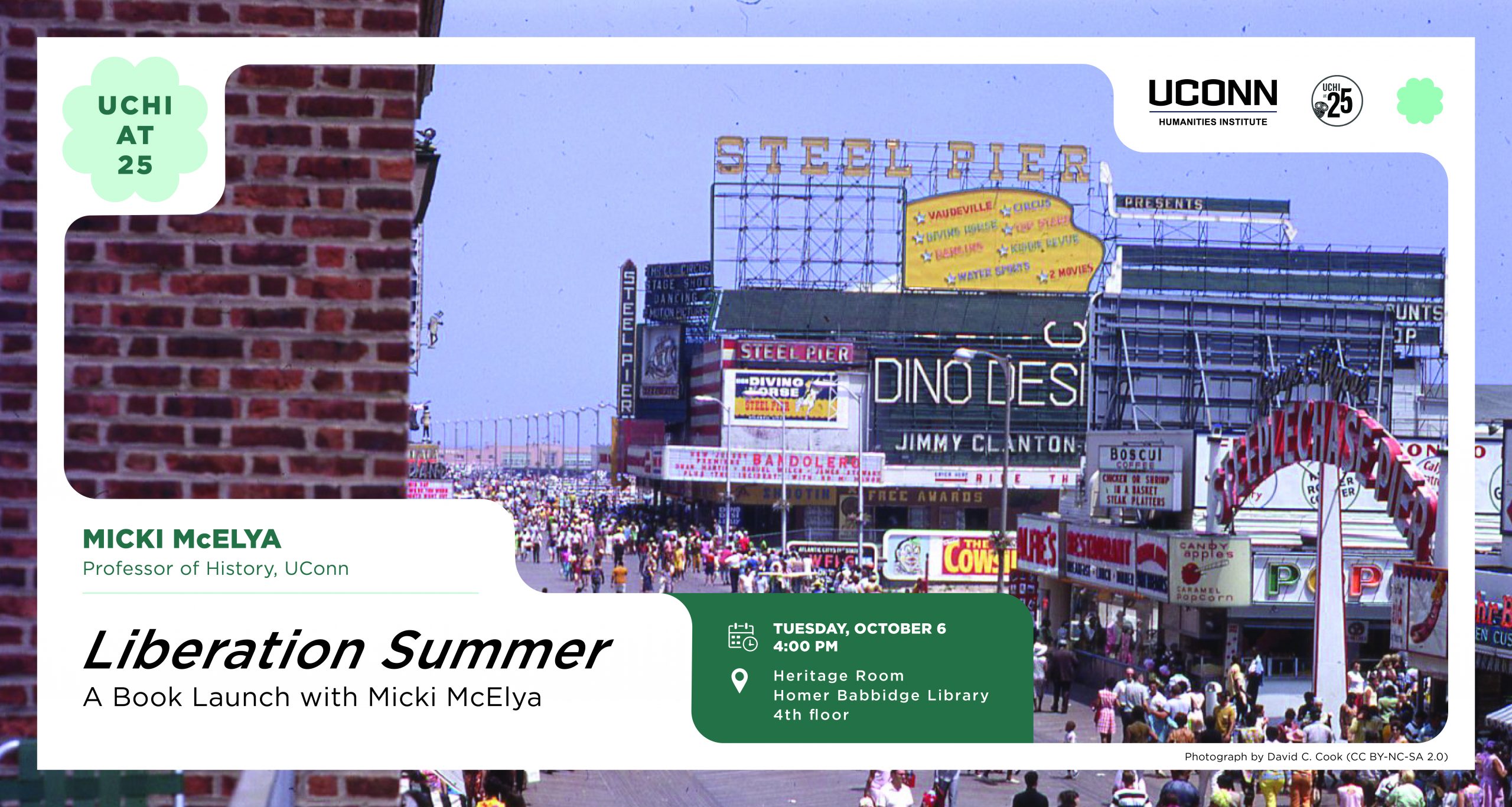
a UCHI at 25 event
Micki McElya (Professor, History, UConn)
Tuesday, October 6, 2026, 4:00pm, Heritage Room, Homer Babbidge Library, 4th Floor
Join us for a celebration of the publication of former UCHI fellow Micki McElya’s new book, Liberation Summer: The Moment That Changed the Women’s Movement and the Future of American Politics (Simon & Schuster).
In the dying days of the summer of 1968 Atlantic City was the site of the first Miss Black America Pageant, mounted to protest its “lily-white” sister competition, as well as raucous actions from women’s liberationists. For just a few hours, the boardwalk became a site of vigorously contested ideas—ideas that would redefine the women’s movement and reverberate across American culture.
Pulitzer Prize finalist Micki McElya unfolds the full scope of this history, detailing the shocking injustices and passionate debates that led to the demonstrations, as well as the broader social and political landscape that gave rise to iconic women on both sides of the ideological spectrum.
After the talk, Professor McElya will be available to sign copies of her book. Light refreshments will be served.
In addition to the book launch, the UConn Humanities Institute and the Africana Studies Institute will host a joint read-along of Liberation Summer, open to faculty and graduate students, culminating in a collaborative discussion of the book on Wednesday February 17th. Sign-up sheets and free copies of the book will be available at Professor McElya’s talk on October 6th. While supplies last, copies will also be available for pickup at UCHI and the Africana Studies Department from October 7th onwards.
Micki McElya is a professor of history at the University of Connecticut, specializing in the histories of women, gender, race, and sexuality in the United States from the Civil War to the present, with an emphasis on political culture and memory. Her book The Politics of Mourning: Death and Honor in Arlington National Cemetery was a finalist for the Pulitzer Prize and received a number of other accolades; her 2007 book, Clinging to Mammy: The Faithful Slave in Twentieth-Century America was the cowinner of a 2007 Outstanding Book Award from the Gustavus Myers Center for the Study of Bigotry and Human Rights. McElya has written for The Atlantic and Boston Review, and her work has been featured in The New York Times, NPR, MSNBC, The Nation, Elle, and more. She is a graduate of Bryn Mawr College and New York University and is a Distinguished Lecturer for the Organization of American Historians. She lives in Cambridge, Massachusetts.
Access note
If you require accommodation to attend this event, please contact us at uchi@uconn.edu or by phone (860) 486-9057. We can request ASL interpretation, computer-assisted real time transcription, and other accommodations offered by the Center for Students with Disabilities. Requests should be made at least five business days in advance whenever possible.
Photography disclaimer
Photographs may be taken at this event and posted on social media or otherwise used for communication purposes.
Support UCHI
For twenty-five years the University of Connecticut Humanities Institute has served as the hub for the study of human society and culture at UConn. Help us celebrate UCHI at 25 with a gift to the Institute. Every gift will help us promote innovation and creativity in humanities research for the next twenty-five years.
 This year is a special one for all of us at UCHI, as we