AI and the Human

Scaling Up: A Pedagogy Workshop

Scaling Up: A pedagogy workshop. May 4, noon-2pm, UCHI Conference Room. Panelists: Ariana Codr, Jane Gordon, Alexander Menrisky, Qazi Arka Rahman, Fiona Somerset

Scaling Up

A Pedagogy Workshop

Monday, May 4, 2026, 12:00–2:00pm, Humanities Institute Conference Room, HBL 4th Floor
This event will also be livestreamed with automated captioning and recorded for later viewing.
Register to attend virtually.

In the age of generative AI, we hear a lot about “scaling up” as a goal we should be striving for. But bigger is not always better, especially when it comes to teaching. This pedagogy workshop is an opportunity for instructors across UConn who are being asked to teach larger classes to talk together about how to make these shifts sustainable.

How can our pedagogy continue to reflect our values and our care for our students, yet without massively increasing our workload? What sorts of assignments develop critical and creative skills that are crucial for students’ futures, rather than the “cognitive offloading” that can result from uncritical dependence on generative AI? How do we assess student work fairly without overburdening instructors and TAs or using digital surveillance? What strategies work to keep student attention and promote genuine learning in a lecture format? Is it possible to meet individual student needs and build community in a larger class?

A panel of five instructors in CLAS at UConn who have successfully scaled up to teaching larger classes will address these and other questions, in a two hour conversation among all participants that we plan to continue beyond this session into next year.

Panelists: Ariana Codr, Jane Gordon, Alexander Menrisky, Qazi Arka Rahman, Fiona Somerset.

Please send questions about the event, or issues you hope the panelists will consider, to fiona.somerset@uconn.edu

Access note

If you require accommodation to attend this event, please contact us at uchi@uconn.edu or by phone (860) 486-9057. We can request ASL interpretation, computer-assisted real time transcription, and other accommodations offered by the Center for Students with Disabilities. Requests should be made at least five business days in advance whenever possible

Will AI Replace Us?

Will AI Replace US? A Panel on AI and the Future of Work. February 4, 12:30-1:30pm, Konover Auditorium. Panelists: Ted Laskaris, Interim Chief Information Officer, UConn James Maroney, CT State Senator Sachin S. Pandya, Roger Sherman Professor of Law, UConn

Will AI Replace Us?

A Panel on AI and the Future of Work

Wednesday, February 4, 2026, 12:30–1:30pm, Konover Auditorium
The event will also be livestreamed.

It’s a question shared by students, staff and faculty: How will Artificial Intelligence shape our workplaces?

Join us for a conversation with experts who are shaping AI policy, practice, and regulation: Ted Laskaris, Interim Chief Information Officer, UConn; CT State Senator James Maroney; and Sachin S. Pandya, Roger Sherman Professor of Law, UConn. Our panelists will share their expertise and field questions from UConn staff, faculty, and students to explore practical questions about workplace transformation, protection, and possibility in the age of AI.

Together, we’ll consider how we can move beyond speculation to understand what AI actually means for the work we do—and the relationships that make that work meaningful.

Please join us—all are welcome! If your class schedule aligns with this event, please feel free to bring your class! Just send a quick email to let us know how many students to expect to uchi@uconn.edu.

This is event is co-sponsored by UCPEA.

Access note

If you require accommodation to attend this event, please contact us at uchi@uconn.edu or by phone (860) 486-9057. We can request ASL interpretation, computer-assisted real time transcription, and other accommodations offered by the Center for Students with Disabilities. Requests should be made at least five business days in advance whenever possible

What Are We Talking About When We Talk About AI?

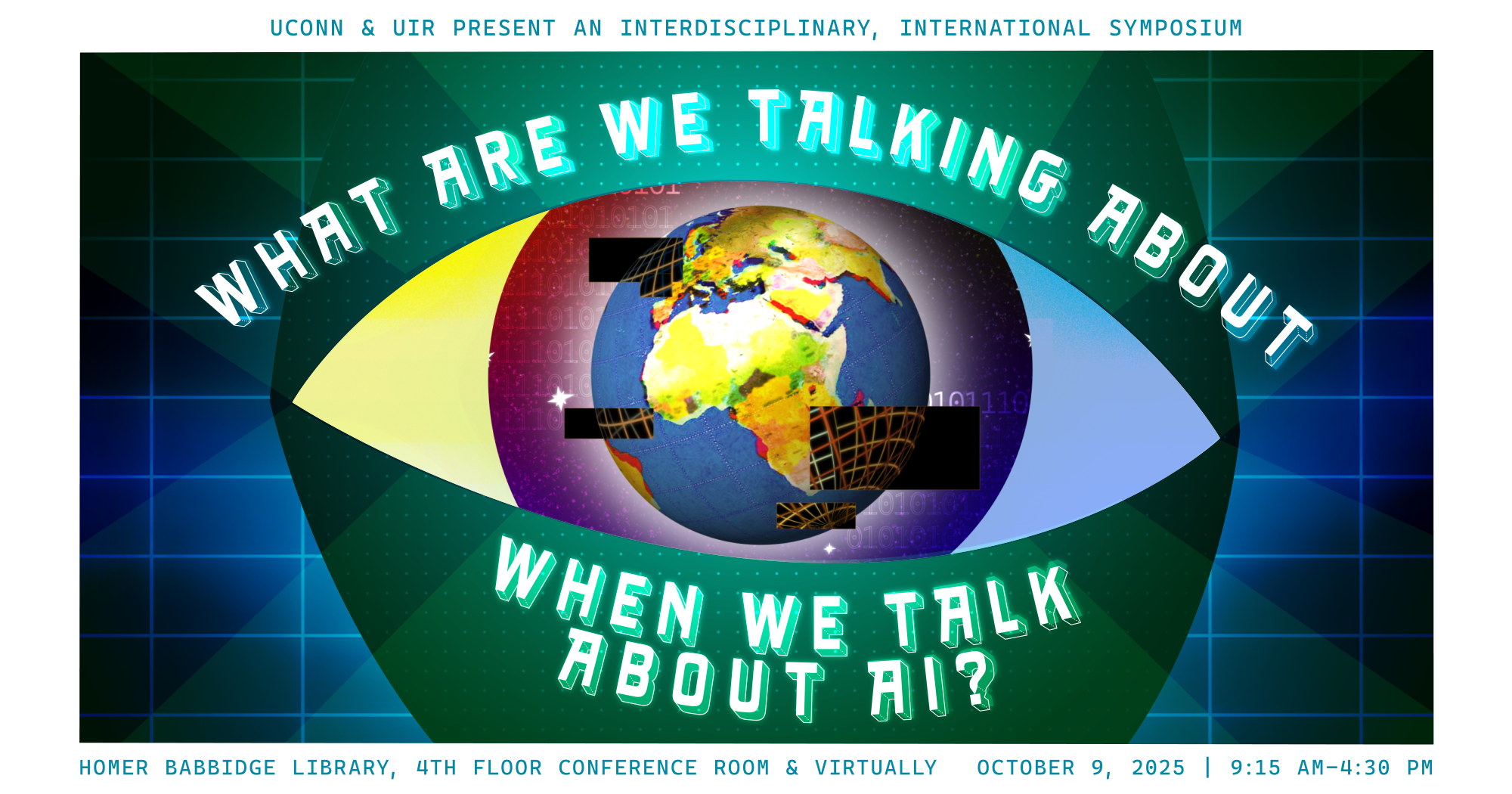
UConn and UIR present and interdisciplinary, international symposium: What are we talking about when we talk about AI?. UCHI Conference Room, Homer Babbidge library, 4th floor. October 9, 9:15am-4:30pm.

The University of Connecticut Humanities Institute and the International University of Rabat presents:

What Are We Talking About When We Talk About AI?

An Interdisciplinary, International Symposium

Thursday, October 9, 2025, 9:15am–4:30pm, Humanities Institute Conference Room (HBL 4-209)
The event will also be livestreamed with automated captioning.

Register to attend virtually Register to attend in person

When computer scientists, philosophers, medical researchers, and legal scholars use words like “learning,” “intelligence,” and “autonomy,” do they mean the same thing? Join us for an international symposium exploring how disciplinary and cultural differences in AI terminology are shaping how artificial intelligence is understood, engaged and developed.

This symposium will address the challenges that language and translation (both conceptual and linguistic) pose to collaboration on AI research. It is part of “Reading Between the Lines: An Interdisciplinary Glossary for Human-Centered AI,” a project is funded by The Consortium of Humanities Centers and Institutes’ Human Craft in the Age of Digital Technologies Initiative.

Schedule

9:15am Coffee and welcome
9:45-10:00am Introductions
10:05-11:30am Panel 1: Care

How might we define how “care” functions via Artificial Intelligence? What are the challenges and opportunities for integrating vulnerable patient voices in healthcare? How is AI changing how we care for one another as AI companions and therapists become more common?

Chair: Jiyoun Suk; Assistant Professor of Communication, University of Connecticut
Panelists:
Anna Mae Duane; Professor of English, University of Connecticut
Ihsane Hmamouchi; Rheumatologist and Epidemiologist, International University of Rabat
Ouassim Karrakchou; Assistant Professor of Computer Science and Digital Engineering, International University of Rabat

11:30am-12:15pm Lunch and Networking
12:15-2:00pm Panel 2: Literacy

What does it mean to be “literate” in AI? This panel will bring together educators, historians, and literary experts to ask how the rise of AI literacy evokes comparisons to past transformations in literacy, and concomitant expansions of democratic and economic participation. What do we risk if we restrict literacy to an elite few? What skill sets are required to make us truly AI literate?

Chair: Tina Huey; Adjunct Professor of English, University of Connecticut
Panelists:
Anke Finger; Professor of German and Comparative Literature, University of Connecticut
Arash Zaghi; Professor of Civil and Environmental Engineering, University of Connecticut
Ting-An Lin; Assistant Professor of Philosophy, University of Connecticut
Hakim Hafidi; Assistant Professor of Computer Science and Digital Engineering, International University of Rabat

2:00-2:15pm Coffee Break
2:20-4:00pm Panel 3: Rights (to Life, Liberty and the Pursuit of Happiness?)

How will AI transform property rights, labor rights and human rights? How does language shape this process?

Chair: Brad Tuttle; Assistant Professor of Journalism, University of Connecticut
Panelists:
John Murphy; Assistant Professor-in Residence of Digital Media Business Strategies, University of Connecticut
Avijit Ghosh; Applied Policy Researcher for the Machine Learning and Society Team at Hugging Face
Meriem Regragui; Professor of Law, International University of Rabat
Michael Lynch; Provost Professor of the Humanities and Board of Trustees Distinguished Professor of Philosophy, University of Connecticut

4:00-4:10pm Closing Remarks, Dean Ofer Harel
4:10-4:30pm Reception

Access note

If you require accommodation to attend this event, please contact us at uchi@uconn.edu or by phone (860) 486-9057. We can request ASL interpretation, computer-assisted real time transcription, and other accommodations offered by the Center for Students with Disabilities. Requests should be made at least five business days in advance whenever possible

UConn Humanities Institute Awarded Grant to Build Glossary for AI Research

The Consortium of Humanities Centers and Institutes (CHCI) has awarded the UConn Humanities Institute (UCHI) a grant of $25,000 for their project “Reading Between the Lines: An Interdisciplinary Glossary for Human-Centered AI.” Funded by CHCI’s Human Craft in the Age of Digital Technologies Initiative, this grant will allow UCHI along with our partners at the International University of Rabat (UIR) to create an interdisciplinary glossary that interrogates the meaning of key AI concepts.

This project brings an international cohort of humanists, engineers, and scientists into conversation through an in-person symposium and a series of podcast dialogues illuminating how the definitions of terms associated with Artificial Intelligence vary widely by discipline, location, and language. The symposium and the podcasts will be structured to address the challenges that language and translation (both conceptual and linguistic) pose to collaboration on AI research.

“We often use the same words—like ‘learning’ or ‘intelligence’—when we are talking about AI, but what those words mean depend on our own academic and cultural background and the assumptions that accompany them,” notes Anna Mae Duane, PI and Director of the UConn Humanities Institute. “The humanities bring crucial insights about language and meaning that can help us to engage these gaps in constructive ways. Working with our partners at the International University of Rabat in Morocco, we’ll bring together voices from computer science, medicine, law, and the humanities to develop better ways of understanding each other and this transformative technology.”

This project showcases UCHI’s interdisciplinarity and its growing global connections. “Reading Between the Lines” draws on the expertise of the Humanistic AI Working Group, a cross-disciplinary team of over twenty UConn researchers, who have been meeting monthly since Fall 2024, and deepens UCHI’s pre-existing partnership with AI scholars at UIR. Through CHCI’s Human Craft in the Age of Digital Technologies Initiative, the grant project will bring UCHI and affiliated faculty into conversation with additional humanities centers and institutes all over the world who are launching projects related to AI, digital technologies, and the human.

The project is being led by Anna Mae Duane, UCHI Director and Professor of English, with the support of collaborators including Clarissa J. Ceglio, UCHI Associate Director of Collaborative Research and Associate Professor of Digital Humanities; Nasya Al-Saidy, UCHI Managing Director; Dan Weiner, Vice Provost of UConn Global Affairs; Allison Cassaly, Global Initiatives Coordinator, UConn Global Affairs; and Ihsane Hmamouchi, Vice-Dean at the International Faculty of Medicine at the International University of Rabat.

Multidisciplinary Team of AI Researchers Led by UCHI Receive Two-Year Grant from CLAS

The College of Liberal Arts and Sciences has awarded a two-year grant of $94,000 for a multidisciplinary team of researchers, led by the UConn Humanities Institute (UCHI), to advance AI research that integrates critical humanistic and social scientific perspectives. Funded by the Strategic Initiative for Multidisciplinary Research program, this grant will build capacity for successfully competing for significant external awards that require or are enhanced by a multidisciplinary approach.

Research stipends, funding for collaborative projects, and structured grant proposal development support will enable members of UCHI’s Human Centered AI team to pursue diverse funding opportunities, while monthly flash talks, human-centered design grant incubators, and targeted feedback will maintain the group’s commitment to deep interdisciplinary collaboration.

“We believe that human-centered AI will only be possible when humans from a truly diverse array of perspectives, backgrounds, and disciplinary training are involved in designing and deploying these powerful tools,” notes Anna Mae Duane, PI and Director of the UConn Humanities Institute.

UCHI’s Human-Centered AI team builds on the Humanistic AI Working Group, a cross-disciplinary team of over twenty UConn researchers, who have been meeting monthly since Fall 2024. The Humanistic AI Working Group brings together faculty from across campus, and across disciplines, to share research, resources, and funding opportunities, and to collaborate on this vital area of research.

The Human-Centered AI team is made up of academics from Statistics, Philosophy, Communications, Geography, Earth Science, Engineering, Computer Science, Journalism, LCL, and English. It ecompasses faculty from junior scholars to senior researchers. Together, this multidisciplinary group has complementary strengths that include AI’s role in human rights, educational accessibility, medical parity, and climate change. The group held its first public-facing event on January 13th, as UConn hosted an international virtual workshop with AI researchers from the International University of Rabat, Morocco.

Key faculty for the Human-Centered AI team include Anna Mae Duane (PI), Professor, English, Director, UCHI; Shiri Dori-Hacohen, Assistant Professor, Computer Science and Engineering; Anke Finger, Professor of German, LCL; Trevor Harris, Assistant Professor, Statistics; Ting-an Lin, Assistant Professor, Philosophy; Jiyoun Suk, Assistant Professor, Communications; Brad Tuttle, Assistant Professor, Journalism; Lijing Wang, Assistant Professor, Earth Science; Arash Zaghi, Professor, School of Civil and Environmental Engineering.

Artificial Intelligence and Artistic Endeavor

Artificial Intelligence and Artistic Endeavor: Pushing the Boundaries of Collaboration and Creativity,Kyle Booten (English, UConn) Austin Choi-Fitzpatrick (Kroc School, University of San Diego), Sue Huang (DMD, UConn). April 18, 3:00pm. Heritage Room, Fourth Floor Homer Babbidge Library.

Artificial Intelligence and Artistic Endeavor: Pushing the Boundaries of Collaboration and Creativity

Kyle Booten (English, UConn)

Austin Choi-Fitzpatrick (Kroc School, University of San Diego)

and Sue Huang (DMD, UConn)

Thursday, April 18, 2024, 3:00pm, Heritage Room, HBL Library, 4th Floor

The event will also be livestreamed with automated captioning.

Register to attend virtually

Join us for an engaging discussion with Austin Choi-Fitzpatrick, human rights expert and member of an artists’ collective; Kyle Booten, co-founder of a literary journal dedicated to human-AI co-authored works; and Sue Huang, a visual artist who collaborates with AI. Together, they will explore how AI challenges us to reassess and redefine the concepts of collaboration and creativity.

“Smooth and Jagged Substrates of Thought,” Kyle Booten

In this talk, I’ll suggest that we should care less about whether or not computer-generated text can be “creative” and more about what sorts of human creativity can grow on top of it, on its surface—much the way lichen grows on bark. Sharing examples of my own work designing algorithmic writing assistants, I will suggest that AI-generated text is often unfortunately “smooth,” and I will share some tactics that I used in my recent book (Salon des Fantômes, Inside the Castle, 2024) to try make it more “jagged” and, perhaps, better for cultivating interestingly-shaped thoughts upon.

“Connective Creativity—Why Art is Collective Action, and How that Matters in the Age of AI,” Austin Choi-Fitzpatrick


“AI, Ecological Intimacies, and the Disappearing Landscape,” Sue Huang

Huang will present recent research which uses AI, scientific “found data” and natural language processing methods for exploring ecological intimacies between humans and nonhumans. In particular, she will speak about her current project Total Archive, a sci-fi performance and installation piece that explores a series of speculative government reports and “strange” objects found in a time capsule from the future. Prepared by an intern working at a government agency, these documents and artifacts reveal an ecological system in its final throes. The project presents poetry written in part by a fine-tuned AI that processes materials from digitized Smithsonian scientific field books and Internet-found amateur written erotica stories. Visuals in the video installation are derived from text-to-image AI and recombinatory methods that hybridize creatures from over 45,000 species listed in the IUCN Red List of Threatened Species database.

Kyle Booten is an assistant professor of English at the University of Connecticut, Storrs. His research explores the ways that small-scale, personalized algorithmic systems may be designed to care for one’s own mind. He is the author of Salon des Fantômes (Inside the Castle, 2014), a book that documents a philosophical salon he attended with a cast of AI-fabricated characters, and the creator of Nightingale, a web extension that re-distracts the user with contextually-relevant excerpts from the poetry of John Keats (available in the Chrome Web Store). His poetry written with algorithmic feedback and interference has been published in Fence, Lana Turner, and Blackbox Manifold; his scholarly writing has recently appeared or is forthcoming in electronic book review, Critical AI, and xCoAx ’23.

Austin Choi-Fitzpatrick is an author, educator, and speaker. His work focuses on politics, culture, technology, and social change. His recent books include Wicked Problems (Oxford, 2022), The Good Drone (MIT Press, 2020) and What Slaveholders Think (Columbia, 2017), and his commentary includes articles in Slate, Al Jazeera, and the Guardian and appearances on BBC, NBC, and Fox News. Austin lives in California and holds academic appointments at the University of San Diego and the University of Nottingham.

Sue Huang is a new media artist whose work addresses collective experience. Her research explores ecological intimacies, human/nonhuman relations, and speculative futures. She is currently working on the project Total Archive, a performance work about a time capsule from the future. This project is supported by the Culture Council of the Emerson Collective and Leonardo @ Djerassi for 2024. Huang has exhibited nationally and internationally, including at the Museum of Contemporary Art (MOCA), Los Angeles; the Contemporary Arts Center (CAC) in Cincinnati; Philadelphia Contemporary; ISEA in Montreal; and Ars Electronica in Linz, Austria; among others. She has previously been an artist-in-residence at LMCC on Governors Island, Creative Science at NEW INC, and the Studios at MASS MoCA. Huang has received funding and project support from Science Sandbox, Rhizome, the James Irvine Foundation (MOCA, Los Angeles), and Creative Scotland (NEoN), the UConn Humanities Institute, among others.She received her MFA in Media Arts at the University of California, Los Angeles (UCLA) and her BS in Science, Technology, and International Affairs from the Walsh School of Foreign Service at Georgetown University. She is an assistant professor of Digital Media and Design at the University of Connecticut.

Access note

If you require accommodation to attend this event, please contact us at uchi@uconn.edu or by phone (860) 486-9057. We can request ASL interpretation, computer-assisted real time transcription, and other accommodations offered by the Center for Students with Disabilities.
Can You Fall in Love with ChatGPT?

Can You Fall in Love with ChatGPT? Panel Discussion: Dan Rockmore, Anna Mae Duane, Stephen Dyson, and Jeffrey Dudas. October 23, 4:00pm. Konover Auditorium.

If you require accommodation to attend this event, please contact us at uchi@uconn.edu or by phone (860) 486-9057. We can request ASL interpreting, computer-assisted real time transcription, and other accommodations offered by the Center for Students with Disabilities.
The Popular Culture Initiative presents:

Can You Fall in Love with ChatGPT?

A Panel Discussion and Live Podcast Recording

October 23, 2023, 4:00pm
Konover Auditorium

A panel discussion and live podcast recording featuring AI expert Dan Rockmore (Dartmouth College), Anna Mae Duane (Director, UCHI), Stephen Dyson (Associate Director, UCHI), and Jeffrey Dudas (UConn Political Science).

How will current and next generation AI reshape our understanding of conversation, companionship, and even love? Taking in the latest technical developments and inspired by movies such as Spike Jonze’s Her, join us! Catered reception to follow. Sponsored by the Popular Culture Initiative of the University of Connecticut Humanities Institute.

Dan Rockmore is professor of mathematics and computer science at Dartmouth College, and the Director of the Neukom Institute for Computational Science. His writings on AI and the humanities have appeared in the New Yorker, LA Review of Books, and Slate.

Anna Mae Duane is Professor of English and Director of the UConn Humanities Institute. She teaches and writes in the fields of American Studies, African American Literature, and the Medical Humanities. She’s particularly interested in how definitions of youth and childhood shape culture and policy in ways that require the abdication of rights in order to claim care. She is the author or editor of six books including Educated for Freedom: The Incredible Story of Two Fugitive Schoolboys who Grew Up to Change a Nation, and Child Slavery Before and After Emancipation: An Argument for Child-Centered Slavery Studies. Her work has been supported by the National Endowment for the Humanities, the Fulbright Foundation, and the Japan-US Friendship Commission. Her public-facing scholarship includes publications in Salon.com, Slate.com, and an ongoing podcast.

Stephen Dyson is the associate director of the University of Connecticut Humanities Institute, and a professor of political science. Dyson’s work concerns the politics of popular culture, especially science fiction, and the psychology of political leadership. He is the author of Imagining Politics (University of Michigan Press, 2019); Otherworldly Politics (Johns Hopkins University Press, 2015); Leaders in Conflict (Manchester University Press, 2014); and The Blair Identity (Manchester University Press, 2009). His work has appeared in Extrapolation, British Politics, International Security, and Political Psychology, among other venues.

Jeffrey R. Dudas is Professor of Political Science and Affiliate Faculty of American Studies at the University of Connecticut. He specializes in the areas of American law, politics, and culture and focuses, in particular, on the many facets of the American politics of rights. He joined the UConn Political Science department in 2004 after earning the M.A. and Ph.D. in Political Science from the University of Washington.