If you require accommodation to attend this event, please contact us at uchi@uconn.edu or by phone (860) 486-9057. We can request ASL interpreting, computer-assisted real time transcription, and other accommodations offered by the Center for Students with Disabilities. Requests should be made at least five business days in advance whenever possible
How to Write Successful Fellowship Applications
October 16, 2026, 12:15pm
Live • Online • Registration Required
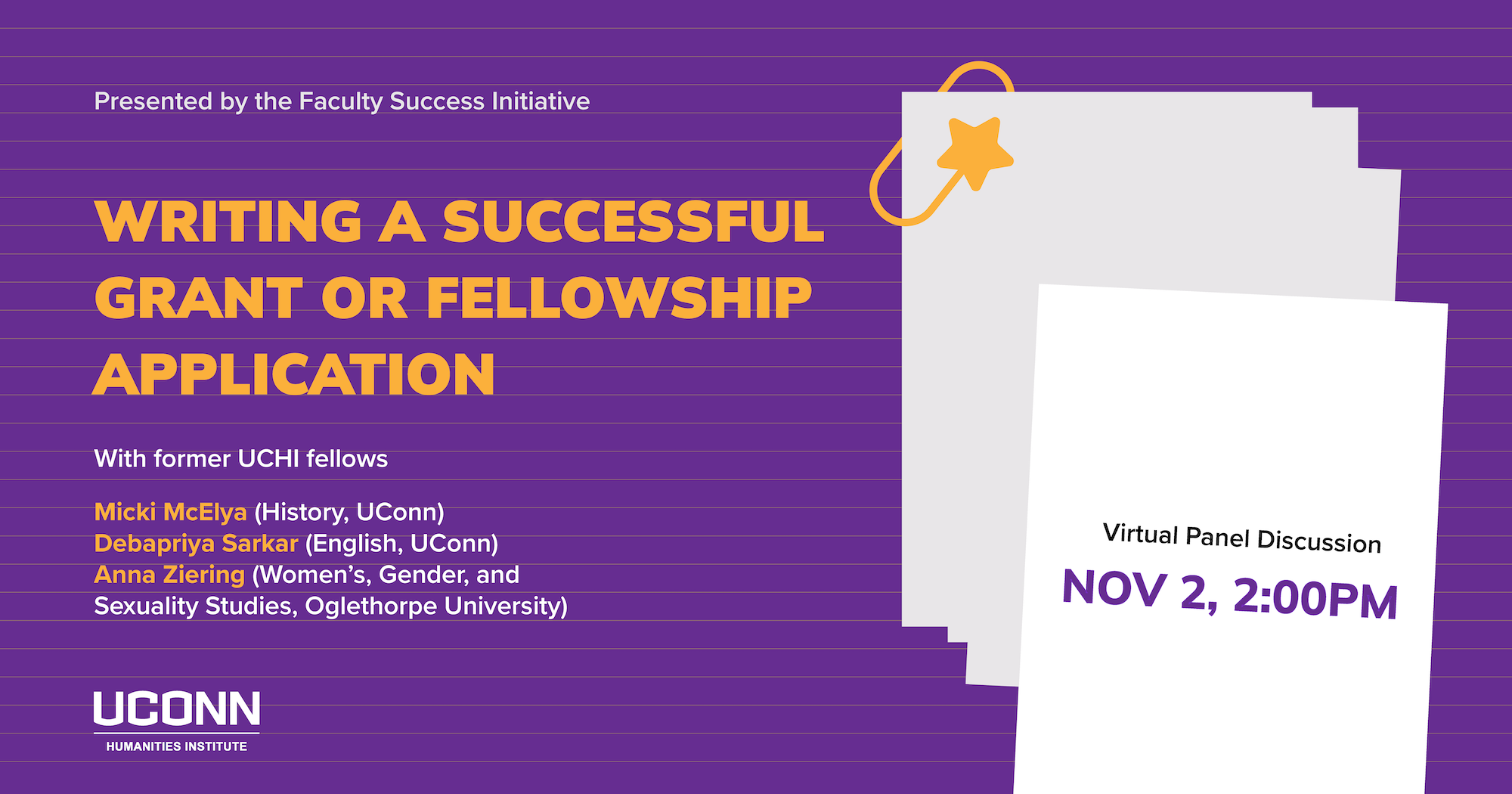
Are you planning to apply for a UCHI fellowship, or other fellowship in the humanities or social sciences? Join us for an advice panel on writing successful fellowship applications!
This panel discussion will feature advice from past UCHI fellows Daniel Hershenzon (LCL), Debapriya Sarkar (English), and Peter Zarrow (History), who have all been successful in their applications for different kinds of fellowships. They will offer best practices for writing your fellowship applications and answer your questions about the application process.
Daniel Hershenzon is an Associate Professor in the Department of Literatures, Cultures, and Languages at the University of Connecticut and a historian of early modern Spain and the Mediterranean. His award-winning book, The Captive Sea: Slavery, Communication, and Commerce in Early Modern Spain and the Mediterranean (University of Pennsylvania Press, 2018), examines the entangled histories of slavery, commerce, and communication across the western Mediterranean. His articles have appeared in Past & Present, Annales HSS, Comparative Studies in Society and History, Law and History Review, Quaderni Storici, and L’Année du Maghreb.
Debapriya Sarkar is an associate professor of English and maritime studies at the University of Connecticut. She is the author of Possible Knowledge: The Literary Forms of Early Modern Science (University of Pennsylvania Press, 2023, paperback 2026). She is currently working on a second book project on early modern poetics and racecraft and (with Hillary Eklund) on the interdisciplinary public humanities project, Waterways: The Early Modern Past and Just Environmental Futures, which aims to foster community-driven, place-based, and historically informed initiatives on environmental studies.
Peter Zarrow has taught in the History Department at UConn since 2014. Prior to that he was a research fellow at the Institute of Modern History at Academia Sinica in Taiwan. His research focuses on modern Chinese intellectual and cultural history, and most recently he has written on such topics as education, utopianism, and the Forbidden City.