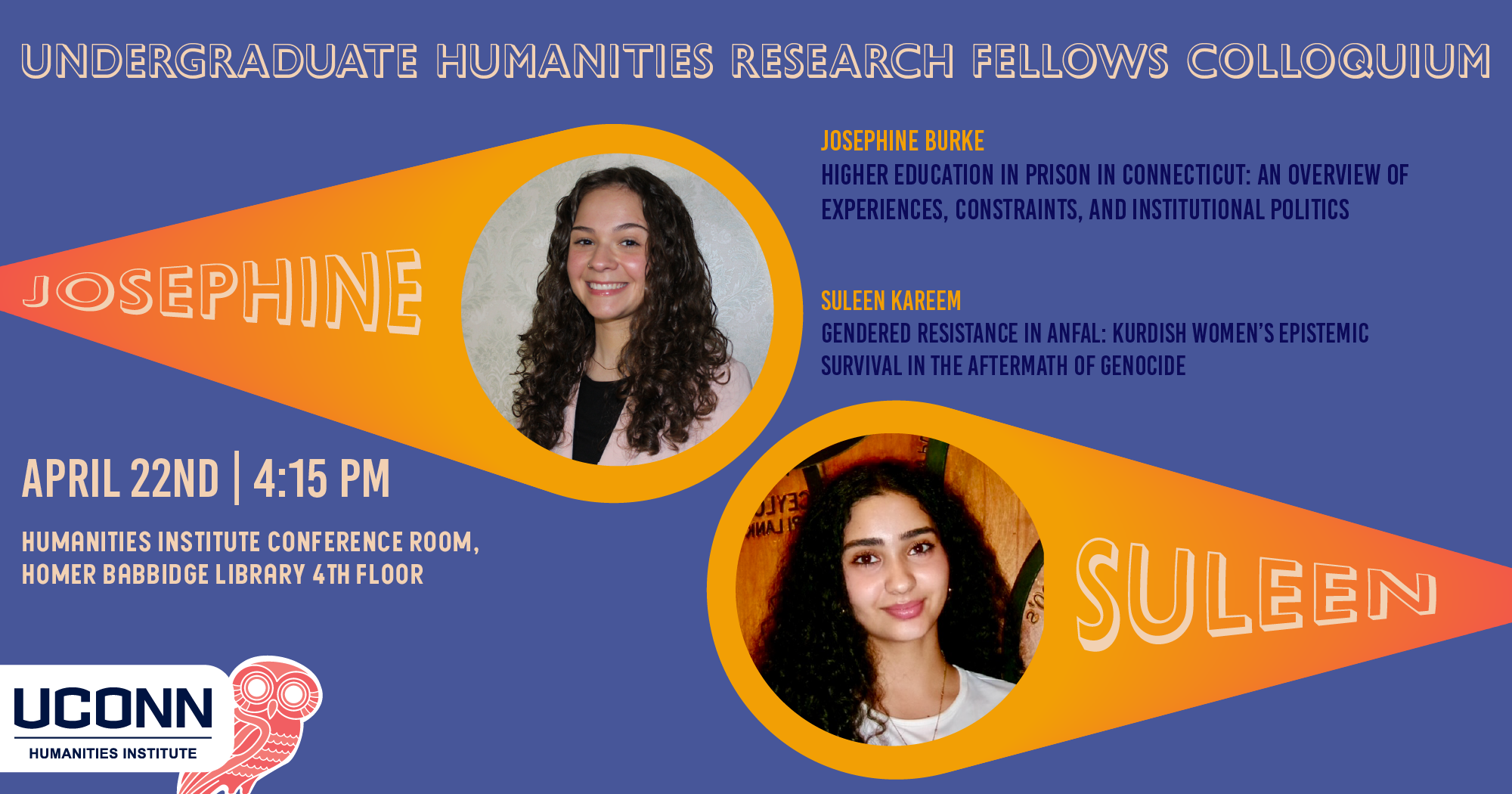
Undergraduate Humanities Fellows Research Colloquium
Josephine Burke (Political Science, UConn) and Suleen Kareem (Human Rights & Philosophy, UConn)
Wednesday, April 22, 2026, 4:15pm, Humanities Institute Conference Room (HBL 4-209)
The event will also be livestreamed with automated captioning.
Josephine Burke, “Higher Education in Prison in Connecticut: An Overview of Experiences, Constraints, and Institutional Politics”
What does it look like to practice higher education in carceral settings, where dynamics of control, power, and violence are omnipresent? What can we learn about the realities of higher education in prison (HEP) from the experiences of professors and former students? This talk will offer an overview of the landscape of higher education in prison in Connecticut, exploring how power relations and institutional interactions at the individual and institutional levels influence the experience of HEP through a discussion of constraints, motivations, and competing understandings.
Josephine Burke is a junior Honors student studying Political Science, American Studies, and History at UConn, Storrs. Her interdisciplinary academic and research interests center around the fields of political theory, critical prison studies, critical university studies, and gender studies, and she is most interested, both within and outside of her research, in the ways in which communities understand, respond to, and resist systems of oppression and control. You can often find Josephine with her nose in a book, immersed in her favorite music, weightlifting at the Rec, or spending quality time with her friends and family. Josephine’s fellowship project advisor is Sandy Grande.
Suleen Kareem, “Gendered Resistance in Anfal: Kurdish Women’s Epistemic Survival in the Aftermath of Genocide”
This talk examines Kurdish women’s experiences of the Anfal Campaign in Iraq (1987–1988) through the lens of epistemic injustice. While existing narratives of genocide have centered on state violence and legal recognition, women’s histories of survival, memory, and resistance remain underrepresented. Drawing on feminist historiography, oral history, and critical epistemology, this project explores how Kurdish women produce and sustain knowledge in the aftermath of violence. Through legal testimonies, oral traditions, and intergenerational memory, their narratives challenge the limits of dominant historical frameworks. In doing so, this research reconsiders what counts as historical knowledge in the study of genocide.
Suleen Kareem is a junior at the University of Connecticut, double majoring in Philosophy and Human Rights. She is the daughter of Kurdish refugees who fled northern Iraq and settled in the United States after surviving mass displacement, executions, and chemical attacks during the Anfal Campaign. These experiences have shaped Suleen’s scholarly interests and commitments, especially to refugee advocacy and the preservation of marginalized histories. Suleen’s fellowship projects advisors are Brendan Kane and Nana Amos.
Access note
If you require accommodation to attend this event, please contact us at uchi@uconn.edu or by phone (860) 486-9057. We can request ASL interpretation, computer-assisted real time transcription, and other accommodations offered by the Center for Students with Disabilities. Requests should be made at least five business days in advance whenever possible.