Faculty Talk: Sandy Grande on Critical Place Theory

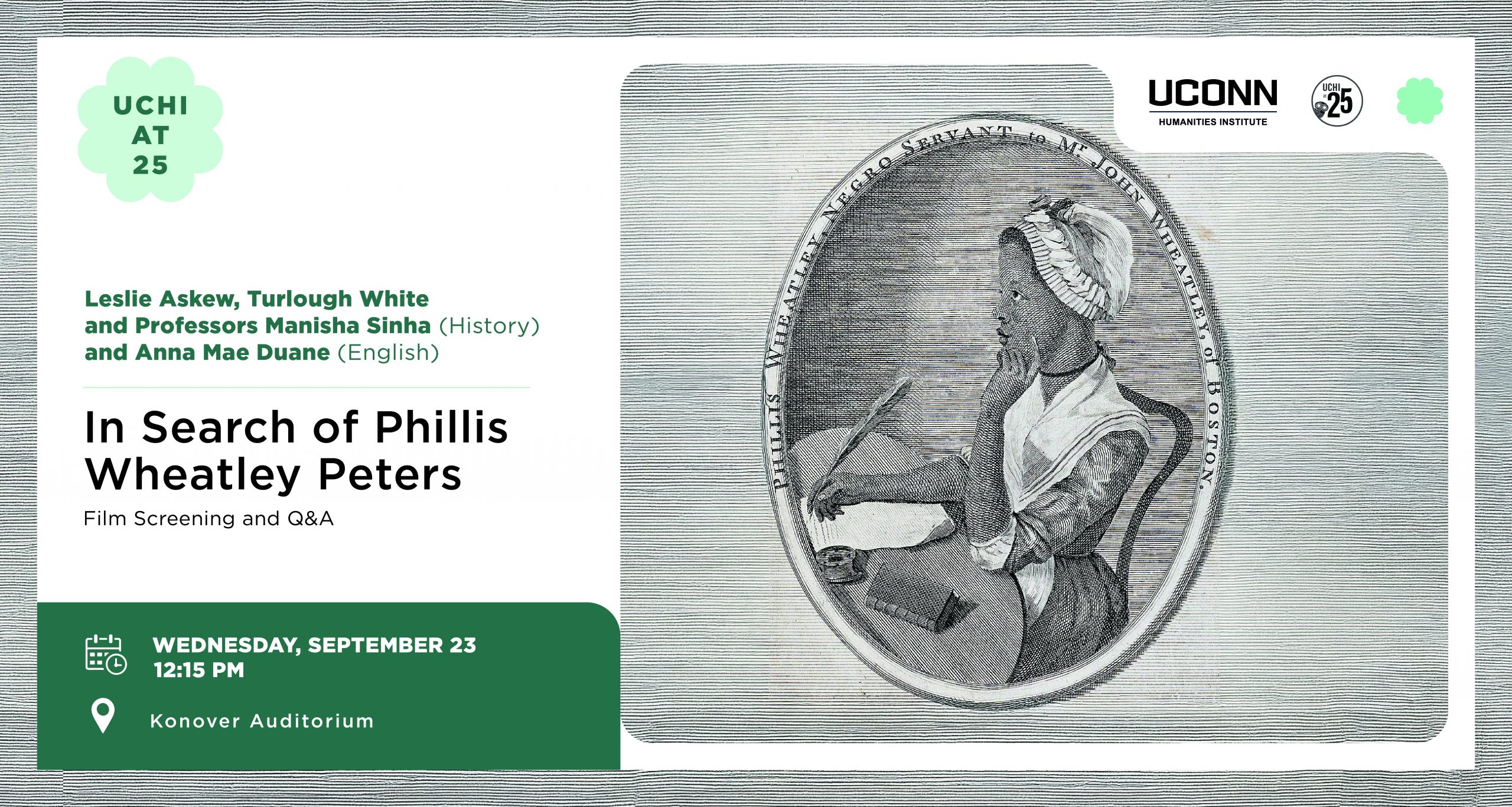
2025-26 UCHI Faculty Talk. "Critical Place Theory" Sandy Grande, Professor of Political Science and Native American and Indigenous Studies. February 11, 12:15pm, UCHI Conference Room, HBL 4th floor.

Critical Place Theory

Sandy Grande (Professor, Political Science & Social and Critical Inquiry, UConn)

Wednesday, February 18, 2026, 12:15pm, Humanities Institute Conference Room (HBL 4-209)

The event will also be livestreamed with automated captioning.

Register to attend virtually

In this presentation, Sandy Grande will explore the epistemic impasses that often emerge between Indigenous and non-Indigenous theories of governance and (human) life. The paper particularly focuses on how the praxis of being of/on land—to be of place—gives rise to different theories and conceptions of governance and power and, therefore, knowledge and liberation.

Sandy Grande is a Professor of Political Science and Native American and Indigenous Studies at the University of Connecticut. Across her work, she aims to produce more nuanced analyses of the colonial present. Her work has been supported by the Ford Foundation, the Mellon Foundation, and more recently by the UConn Humanities Institute and the Institute for Collaboration on Health, Intervention, and Policy, for her new project on Indigenous Elders and aging. She has also published numerous book chapters and articles and her book, Red Pedagogy: Native American Social and Political Thought was published in a 10th anniversary edition, and a Portuguese translation is anticipated to be published in Brazil in 2025. In addition to publishing numerous articles and book chapters, she is a founding member of New York Stands for Standing Rock. As one of their projects, they published the Standing Rock Syllabus. In addition to her academic and organizing work, she is most proud of providing eldercare for her parents up until and through their passage elsewhere.

Access note

If you require accommodations to attend this event, please contact us at uchi@uconn.edu or by phone (860) 486-9057. We can request ASL interpretation, computer-assisted real time transcription, and other accommodations offered by the Center for Students with Disabilities. Requests should be made at least five business days in advance whenever possible

Fellow’s Talk: Harry van der Hulst on Sign Languages

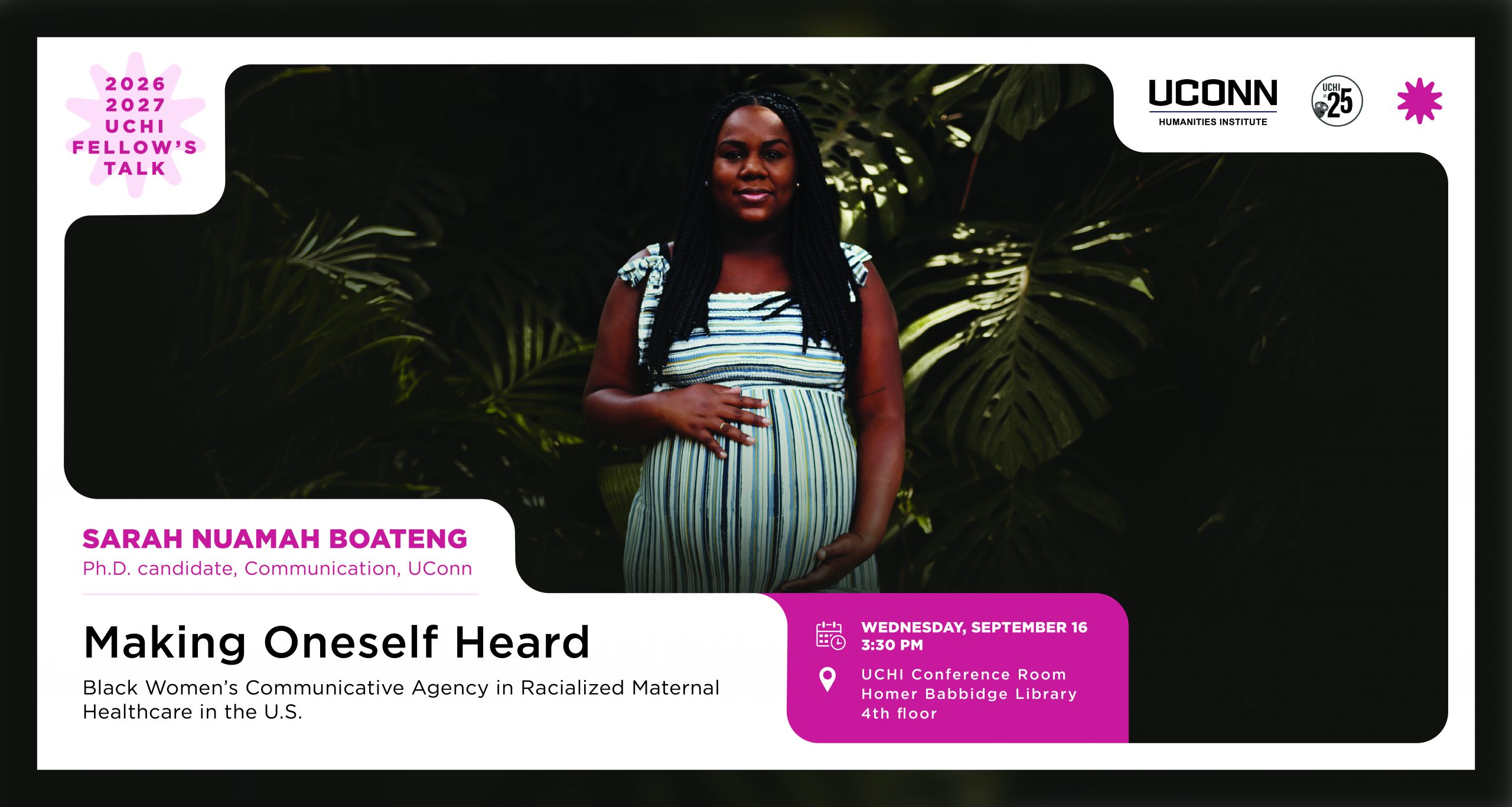
2025–26 UCHI Fellow's Talk. “How the recent emergence of new sign languages can shed light on how human languages came about in the far past,” Harry van der Hulst, Professor of Linguistics. With a response by Ashmita Mukherjee. February 18, 3:30pm.

How the recent emergence of new sign languages can shed light on how human languages came about in the far past

Harry van der Hulst (Professor, Linguistics, UConn)

with a response by Ashmita Mukherjee (Literatures, Cultures, and Languages, UConn)

Wednesday, February 18, 2026, 3:30pm, Humanities Institute Conference Room (HBL 4-209)

The event will also be livestreamed with automated captioning.

Register to attend

In this talk Harry van der Hulst will first discuss the goal of his current project which is to write a book that explains why we say that sign languages are real and full-fledged human languages. His current focus is on one chapter in this book which deals with evolutionary questions concerning the origin of human language, both spoken and signed. While the origin of human language is hidden in the prehistoric past, which means that direct evidence for its emergence is in principle not available, for some time researchers from many different disciplines have shown that there is potential ‘circumstantial’ evidence based on the study of attested languages (their grammars and use), their documented history, archeology, ethology (the study of animal behavior), stages in child language acquisition, among others, that can serve as ‘windows’ on early (and undocumented) stages of human language. In this endeavor, sign languages that have recently come into existence provide a particularly interesting window given that various stages in their development have been documented by sign linguists.

Harry van der Hulst (PhD 1984, Leiden University, Netherlands) specializes in phonology (of spoken and signed languages). He has published 5 books, over 180 articles, (co-)edited 32 books and 6 journal theme issues, among them The Oxford Handbook of Vowel Harmony (with Nancy Ritter) in 2024. He is Editor-in-Chief of The Linguistic Review. He is professor of linguistics at the University of Connecticut.

Ashmita Mukherjee is a doctoral researcher in Comparative Literature at the University of Connecticut. Her dissertation, “Textual Pleasures: Amusement and Affect in Post/Colonial India (1850-1950),” examines the role of literary amusement as a tool for anti-colonial resistance. She is interested in global 19th-20th century, theories of emotion and affect, South Asian Studies, world literature and culture, public humanities, and digital media. She has published articles in Literature/Film Quarterly and South Asian Review, and is a creator and co-host at the YouTube channel @theantilibrarypodcast.

Access note

If you require accommodation to attend this event, please contact us at uchi@uconn.edu or by phone (860) 486-9057. We can request ASL interpretation, computer-assisted real time transcription, and other accommodations offered by the Center for Students with Disabilities. Requests should be made at least five business days in advance whenever possible.

Humanities Involvement Fair

Humanities Involvement Fair. February 11, 12:30-4:30pm. Student Union 311.

Humanities Involvement Fair

Wednesday, February 11, 2026, 12:30–4:30pm, Student Union 331

Want to learn more about humanities, social science, and arts related activities at UConn? Drop in to the Humanities Involvement Fair. Representatives from clubs, groups, and units across campus will share information about their programs, opportunities, and more.

Access note

If you require accommodation to attend this event, please contact us at uchi@uconn.edu or by phone (860) 486-9057. We can request ASL interpretation, computer-assisted real time transcription, and other accommodations offered by the Center for Students with Disabilities. Requests should be made at least five business days in advance whenever possible

Fellow’s Talk: Fiona Somerset on Indigeneity and Consent

2025-26 UCHI Fellow's Talk. "Land and People: Indigeneity and Consent in Lawman's Brut" Fiona Somerset, Professor of Comparative Literature and Social and Critical Inquiry, with a response by April Anson. February 4, 3:30pm, UCHI Conference Room.

Land and People: Indigeneity and Consent in Lawman’s Brut

Fiona Somerset (Professor, LCL & Social and Critical Inquiry, UConn)

with a response by April Anson (English & Social and Critical Inquiry, UConn)

Wednesday, February 4, 2026, 3:30pm, Humanities Institute Conference Room (HBL 4-209)

The event will also be livestreamed with automated captioning.

Register to attend

Far-right nationalists have appropriated the concept of indigeneity in recent years to create isolationist arguments (one land, one language, one people). Recently, historians have worked to counter these claims by suggesting that until the Enlightenment, people in Europe did not have a concept of indigeneity, because they did not have a concept of popular consent. The book I am writing on the history of consent demonstrates otherwise: in this talk I will show how the early thirteenth century English writer Lawman in his historical poem the Brut develops a theory of indigeneity based on popular consent. However, Lawman’s understanding of indigeneity tends to delegitimize far-right nationalist arguments, rather than supporting them.

Fiona Somerset is Professor of Comparative Literature and Culture and of Social and Critical Inquiry at the University of Connecticut, where she has served as Codirector of Comparative Literary and Cultural Studies and Interim Director of Women’s, Gender, and Sexuality Studies. She is finishing work on a book on the medieval history of consent through silence, and preparing to write another book on personhood in the Middle Ages.

April Anson is an assistant professor of English and Social and Critical Inquiry at the University of Connecticut where she serves on the executive committees for American Studies and Native American and Indigenous Studies. Prior to joining UConn, Dr. Anson was assistant professor of Public Humanities at San Diego State University and a Mellon Postdoctoral Fellow at the University of Pennsylvania. Dr. Anson works at the intersection of environmental humanities, Indigenous American studies, and political theory.

Access note

If you require accommodation to attend this event, please contact us at uchi@uconn.edu or by phone (860) 486-9057. We can request ASL interpretation, computer-assisted real time transcription, and other accommodations offered by the Center for Students with Disabilities. Requests should be made at least five business days in advance whenever possible.

Will AI Replace Us?

Will AI Replace US? A Panel on AI and the Future of Work. February 4, 12:30-1:30pm, Konover Auditorium. Panelists: Ted Laskaris, Interim Chief Information Officer, UConn James Maroney, CT State Senator Sachin S. Pandya, Roger Sherman Professor of Law, UConn

Will AI Replace Us?

A Panel on AI and the Future of Work

Wednesday, February 4, 2026, 12:30–1:30pm, Konover Auditorium
The event will also be livestreamed.

It’s a question shared by students, staff and faculty: How will Artificial Intelligence shape our workplaces?

Join us for a conversation with experts who are shaping AI policy, practice, and regulation: Ted Laskaris, Interim Chief Information Officer, UConn; CT State Senator James Maroney; and Sachin S. Pandya, Roger Sherman Professor of Law, UConn. Our panelists will share their expertise and field questions from UConn staff, faculty, and students to explore practical questions about workplace transformation, protection, and possibility in the age of AI.

Together, we’ll consider how we can move beyond speculation to understand what AI actually means for the work we do—and the relationships that make that work meaningful.

Please join us—all are welcome! If your class schedule aligns with this event, please feel free to bring your class! Just send a quick email to let us know how many students to expect to uchi@uconn.edu.

This is event is co-sponsored by UCPEA.

Access note

If you require accommodation to attend this event, please contact us at uchi@uconn.edu or by phone (860) 486-9057. We can request ASL interpretation, computer-assisted real time transcription, and other accommodations offered by the Center for Students with Disabilities. Requests should be made at least five business days in advance whenever possible

Undergraduate Research Fellowship Information Session

Undergraduate Research Fellowship Information Session. January 29, 4:00pm. Virtual.

If you require accommodation to attend this event, please contact us at uchi@uconn.edu or by phone (860) 486-9057. We can request ASL interpreting, computer-assisted real time transcription, and other accommodations offered by the Center for Students with Disabilities.

Undergraduate Research Fellowship Information Session

January 29, 2026, 4:00pm
Live • Online • Registration required

Register

Interested in applying for a humanities undergraduate research fellowship but don’t know where to start?

We are holding an information session for prospective applicants for the 2026–27 Humanities Research Fellowship—a year-long fellowship for UConn undergraduates pursuing innovative research in the humanities. In this session, we will go over the application process, offer tips and tricks for writing a compelling application, and answer questions.

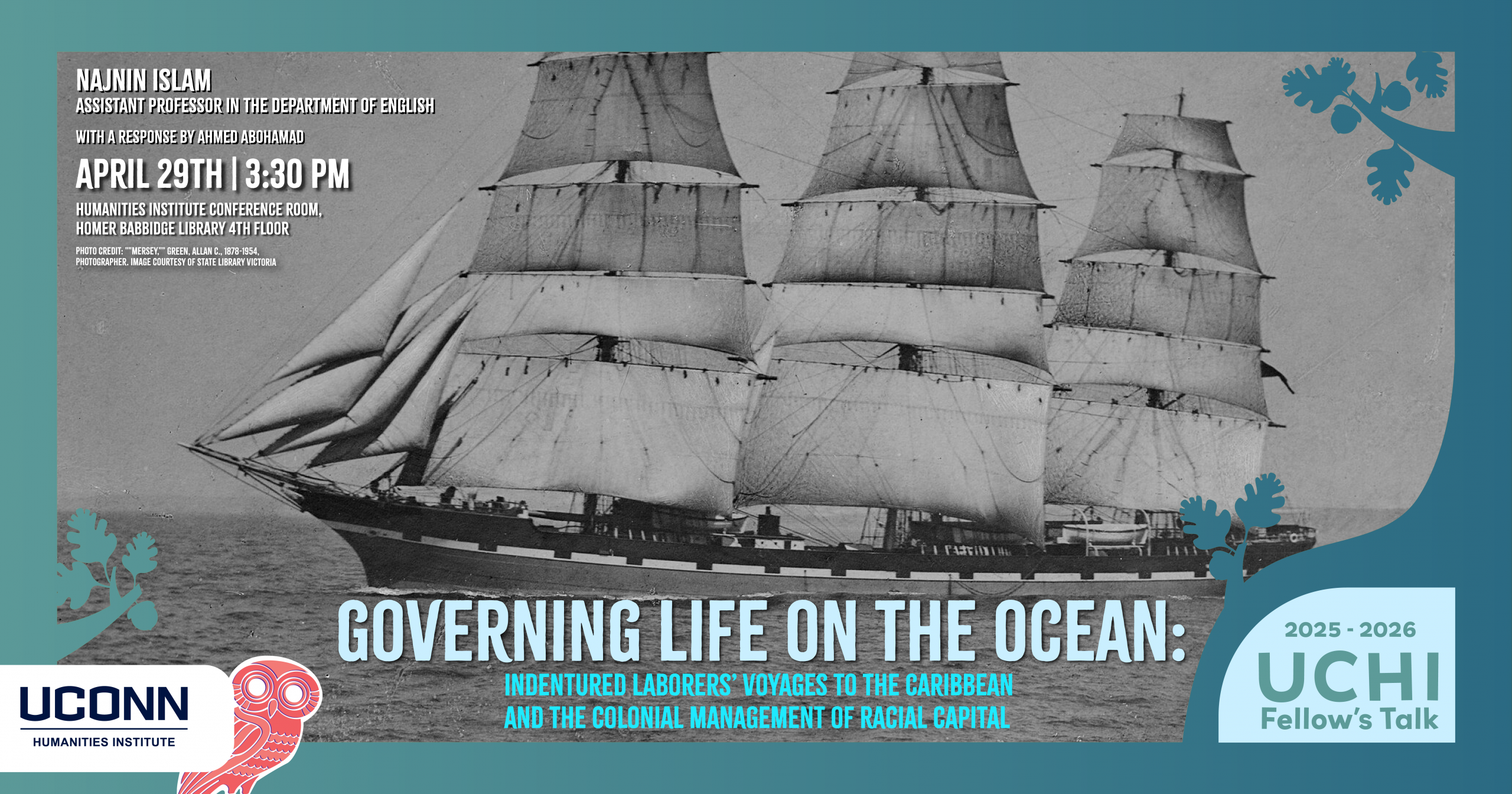
Fellow’s Talk: Peter Constantine on Language Reclamation

2025-26 UCHI Fellow's Talk. “When Long-Silent Languages Return: Indigenous Reclamation in Action." Peter Constantine, Professor, LCL, UConn, with a response by Najnin Islam. December 3, 3:30pm, UCHI Conference Room, HBL 4th floor.

When Long-Silent Languages Return: Indigenous Reclamation in Action

Peter Constantine (Professor, LCL, UConn)

with a response by Najnin Islam (English, UConn)

Wednesday, Decmeber 3, 2025, 3:30pm, Humanities Institute Conference Room (HBL 4-209)

The event will also be livestreamed with automated captioning.

Register to attend

In my talk I plan to discuss strategies used by indigenous communities throughout the world to reclaim their extinct heritage languages, examining both the reasons for wanting to revive languages that in some cases have not been spoken for centuries and the different methods used by these communities to do so. I have both a professional and personal interest in language reclamation as I grew up in Attica and Corinth speaking Arvanitika, a severely endangered non-Greek language of Greece. Since the last speakers and semi-speakers of Arvanitika are of my generation and older, our language is facing inevitable extinction.

In my talk I aim to focus exclusively on extinct languages that are being reclaimed, as opposed to severely endangered languages that are being revitalized with the help of a few remaining fluent or terminal speakers. In the case of language reclamation, linguists and communities typically use written documentation by non-native settlers, early travelers, and missionaries to revive and recreate an extinct language.

I also plan to touch on the different expectations of communities seeking to reclaim their language and give examples of different projects. Še:wey Čahnu, for instance, is a pidgin of California’s Southern Pomo language, which linguists have recently constructed in order to offer the community easy access to a simplified version of their heritage language that has extraordinarily complex grammatical structures. Palawa Kani is a new language constructed by the Tasmanian Aboriginal Centre using fragmentary eighteenth- and nineteenth-century wordlists from a number of different extinct Tasmanian languages to create something new. Nynorn, “New Norn,” is a revived form of Norn, a Scandinavian language of Shetland and Orkney that went out of daily use in the eighteenth century.

Reclamation projects rarely aim to recreate a language exactly as it once was. Something new inevitably emerges. At a time when the world is losing languages at an alarming pace, these efforts represent both resistance and renewal.

Peter Constantine’s translations include works by Rousseau, Machiavelli, Gogol and Tolstoy for Random House, Modern Library. He is a Guggenheim Fellow and was awarded the PEN Translation Prize and the National Translation Award. He is among the last speakers of Arvanitika, a severely endangered language of Greece, and is currently involved in documentation, conservation, and revitalization efforts. He is a professor of translation studies at the University of Connecticut and publisher of World Poetry Books.

Najnin Islam is Assistant Professor of English at the University of Connecticut. Her research focuses on post-emancipation labor economies in the Caribbean and the Indian Ocean world. Her work has been published in journals such as Small Axe, ARIEL, Interventions, Global South Studies, and Verge. She has also written for Adam Matthew Digital and a pedagogical essay of hers is forthcoming in the edited volume MLA Options for Teaching: Food in Literature. Her research has received support through the NEH and other institutional funding. During her time at the UCHI, she will work on her current book project that examines the entangled histories of race and caste in the Anglophone Caribbean after emancipation, particularly during the era of Indian indentureship.

Access note

If you require accommodation to attend this event, please contact us at uchi@uconn.edu or by phone (860) 486-9057. We can request ASL interpretation, computer-assisted real time transcription, and other accommodations offered by the Center for Students with Disabilities. Requests should be made at least five business days in advance whenever possible.

Fellow’s Talk: Fumilayo Showers on Aspiring Migrants and the Afropolitan Imaginary

2025-26 UCHI Fellow's Talk. "The Afropolitan Imaginary and Migrant Aspirations in a Migrant Sending Nation." Fumilayo Showers, assistant professor of sociology, with a response by Anna Mae Duane. November 19, 3:30 pm. UCHI Conference Room.

The “Afropolitan Imaginary” and Migration Aspirations in a Migrant Sending Nation

Fumilayo Showers (Assistant Professor, Sociology, UConn)

with a response by Anna Mae Duane (English, UConn)

Wednesday, November 19, 2025, 3:30pm, Humanities Institute Conference Room (HBL 4-209)

The event will also be livestreamed with automated captioning.

Register to attend

International migration conjures up high hopes and deep fears. Hopes for the migrants themselves, for those they leave behind in the sending nations from which they derive, and sometimes, fears for the receiving nations to which they arrive.

In this talk, I draw attention to migration aspirations—the first, but often understudied stage, in migration projects. I illuminate the experiences of a group of migrants that have received lesser attention in international migration/mobility scholarship—aspiring migrants (people who have yet to leave the home country). Drawing from a case study of medical students in Ghana, West Africa, (a group invisible in studies and depictions of the hypermobile and cosmopolitan international student), allows for engagement with articulations of Afropolitanism. Afropolitanism as an analytic concept, a cultural discourse, and a mode being in the world, highlights a subset of African-origin individuals as global citizens who are making claims to a cosmopolitanism that its proponents argue has previously been denied to Africans.

I provide a rich alternative to popular understandings of migrants as feverishly leaving at all costs in search of a “better life,” and neo-classical economic models of migration where migratory movements are narrowly attributed to rational economic cost-and-benefit analyses among individual actors. I argue that migration may be imagined as temporary and inspired by factors other than economic and socio-political ones, including affective, emotional, and cosmopolitan desires. I reveal migration desires that are imagined as part of a transient stage in the life course, to escape under resourced educational environments, build human capital, broaden life goals, and to return to contribute to the homeland.

Fumilayo Showers is Assistant Professor of Sociology and Africana Studies at the University of Connecticut. Her research interests center on international migration; immigrant labor and entrepreneurship; African immigrants in the US; and health professions (medicine and nursing). She is the author of Migrants Who Care: West Africans Working and Building Lives in US Health Care (Rutgers University Press, 2023).

Anna Mae Duane is Professor of English and Director of the UConn Humanities Institute. She teaches and writes in the fields of American Studies, African American Literature, and the Medical Humanities. She’s particularly interested in how definitions of youth and childhood shape culture and policy in ways that require the abdication of rights in order to claim care. She is the author or editor of six books including Educated for Freedom: The Incredible Story of Two Fugitive Schoolboys who Grew Up to Change a Nation, and Child Slavery Before and After Emancipation: An Argument for Child-Centered Slavery Studies. Her work has been supported by the National Endowment for the Humanities, the Fulbright Foundation, and the Japan-US Friendship Commission.

Access note

If you require accommodation to attend this event, please contact us at uchi@uconn.edu or by phone (860) 486-9057. We can request ASL interpretation, computer-assisted real time transcription, and other accommodations offered by the Center for Students with Disabilities. Requests should be made at least five business days in advance whenever possible.

Undergraduate Research Fellowship Information Session

Undergraduate Research Fellowship Information Session. November 13, 4:00pm. Virtual.

If you require accommodation to attend this event, please contact us at uchi@uconn.edu or by phone (860) 486-9057. We can request ASL interpreting, computer-assisted real time transcription, and other accommodations offered by the Center for Students with Disabilities.

Undergraduate Research Fellowship Information Session

November 13, 2025, 4:00pm
Live • Online • Registration required

Register

Interested in applying for a humanities undergraduate research fellowship but don’t know where to start?

We are holding an information session for prospective applicants for the 2026–27 Humanities Research Fellowship—a year-long fellowship for UConn undergraduates pursuing innovative research in the humanities. In this session, we will go over the application process, offer tips and tricks for writing a compelling application, and answer questions.

Pick up the Thread: One Year Later

The Humanities Institute and the Well-Being Collective present: Pick Up the Thread, One Year Later. November 13, 1-3pm, Native American Cultural Programs, SU 103.

If you require accommodation to attend this event, please contact us at uchi@uconn.edu or by phone (860) 486-9057. We can request ASL interpreting, computer-assisted real time transcription, and other accommodations offered by the Center for Students with Disabilities.

Pick Up the Thread: A Post-Election Connection, One Year Later

November 13, 2025, 1:00–3:00pm
Native American Cultural Programs Space, SU 103

The Well-Being Collective and the Humanities Institute, with the support of the UConn Library, Native American Cultural Programs, Student Activities, and Student Health and Wellness, present a moment of pause, inclusivity, and reflection one year after the 2024 election.

All members of the UConn community are encouraged to join in this moment of pause, inclusivity, and reflection one year after the 2024 election. Come to relax, reflect, and share in collective art-making and meaningful dialogue. There will be faculty and staff experts to help facilitate conversations, and materials for a collective fiber arts project—representing the thread that weaves us all together—will be provided should you feel called to learn or contribute to the endeavor. We invite everyone to explore ways to create and maintain community in politically charged times.

This event is taking place as part of a day of Post-Election Connections, featuring a Well-Being collective forum from 10:30am-12:00pm (Student Union 104), and a Know Your Rights workshop with Junta hosted by the Rainbow Center Out to Lunch Lecture Series at 12:00pm (Rainbow Center, Storrs, Student Union 403).