The University of Connecticut Humanities Institute and the International University of Rabat presents:
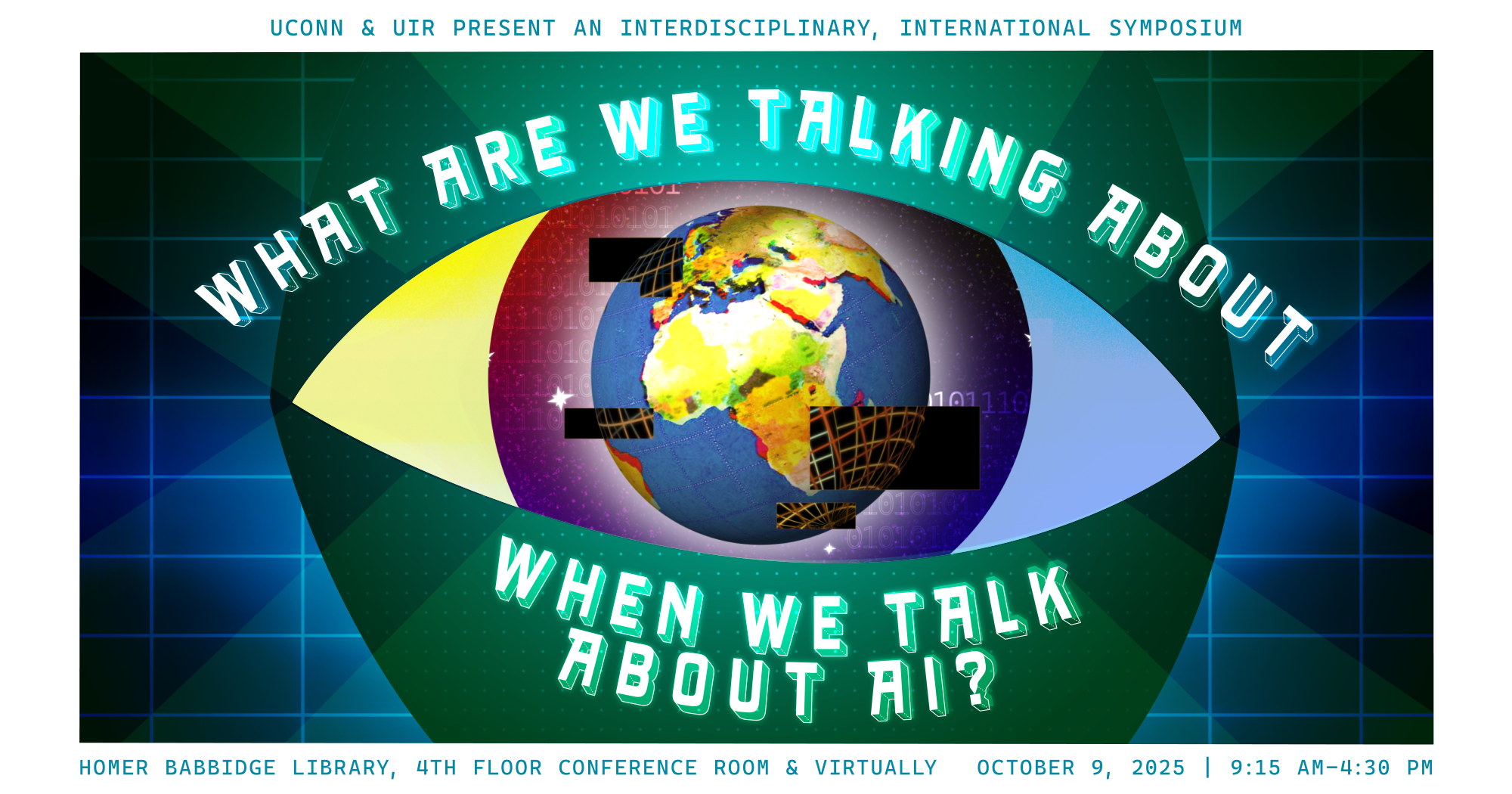
What Are We Talking About When We Talk About AI?
An Interdisciplinary, International Symposium
Thursday, October 9, 2025, 9:15am–4:30pm, Humanities Institute Conference Room (HBL 4-209)
The event will also be livestreamed with automated captioning.
Register to attend virtually Register to attend in person
When computer scientists, philosophers, medical researchers, and legal scholars use words like “learning,” “intelligence,” and “autonomy,” do they mean the same thing? Join us for an international symposium exploring how disciplinary and cultural differences in AI terminology are shaping how artificial intelligence is understood, engaged and developed.
This symposium will address the challenges that language and translation (both conceptual and linguistic) pose to collaboration on AI research. It is part of “Reading Between the Lines: An Interdisciplinary Glossary for Human-Centered AI,” a project is funded by The Consortium of Humanities Centers and Institutes’ Human Craft in the Age of Digital Technologies Initiative.
Schedule
9:15am Coffee and welcome
9:45-10:00am Introductions
10:05-11:30am Panel 1: Care
How might we define how “care” functions via Artificial Intelligence? What are the challenges and opportunities for integrating vulnerable patient voices in healthcare? How is AI changing how we care for one another as AI companions and therapists become more common?
Chair: Jiyoun Suk; Assistant Professor of Communication, University of Connecticut
Panelists:
Anna Mae Duane; Professor of English, University of Connecticut
Ihsane Hmamouchi; Rheumatologist and Epidemiologist, International University of Rabat
Ouassim Karrakchou; Assistant Professor of Computer Science and Digital Engineering, International University of Rabat
11:30am-12:15pm Lunch and Networking
12:15-2:00pm Panel 2: Literacy
What does it mean to be “literate” in AI? This panel will bring together educators, historians, and literary experts to ask how the rise of AI literacy evokes comparisons to past transformations in literacy, and concomitant expansions of democratic and economic participation. What do we risk if we restrict literacy to an elite few? What skill sets are required to make us truly AI literate?
Chair: Tina Huey; Adjunct Professor of English, University of Connecticut
Panelists:
Anke Finger; Professor of German and Comparative Literature, University of Connecticut
Arash Zaghi; Professor of Civil and Environmental Engineering, University of Connecticut
Ting-An Lin; Assistant Professor of Philosophy, University of Connecticut
Hakim Hafidi; Assistant Professor of Computer Science and Digital Engineering, International University of Rabat
2:00-2:15pm Coffee Break
2:20-4:00pm Panel 3: Rights (to Life, Liberty and the Pursuit of Happiness?)
How will AI transform property rights, labor rights and human rights? How does language shape this process?
Chair: Brad Tuttle; Assistant Professor of Journalism, University of Connecticut
Panelists:
John Murphy; Assistant Professor-in Residence of Digital Media Business Strategies, University of Connecticut
Avijit Ghosh; Applied Policy Researcher for the Machine Learning and Society Team at Hugging Face
Meriem Regragui; Professor of Law, International University of Rabat
Michael Lynch; Provost Professor of the Humanities and Board of Trustees Distinguished Professor of Philosophy, University of Connecticut
4:00-4:10pm Closing Remarks, Dean Ofer Harel
4:10-4:30pm Reception
Access note
If you require accommodation to attend this event, please contact us at uchi@uconn.edu or by phone (860) 486-9057. We can request ASL interpretation, computer-assisted real time transcription, and other accommodations offered by the Center for Students with Disabilities. Requests should be made at least five business days in advance whenever possible