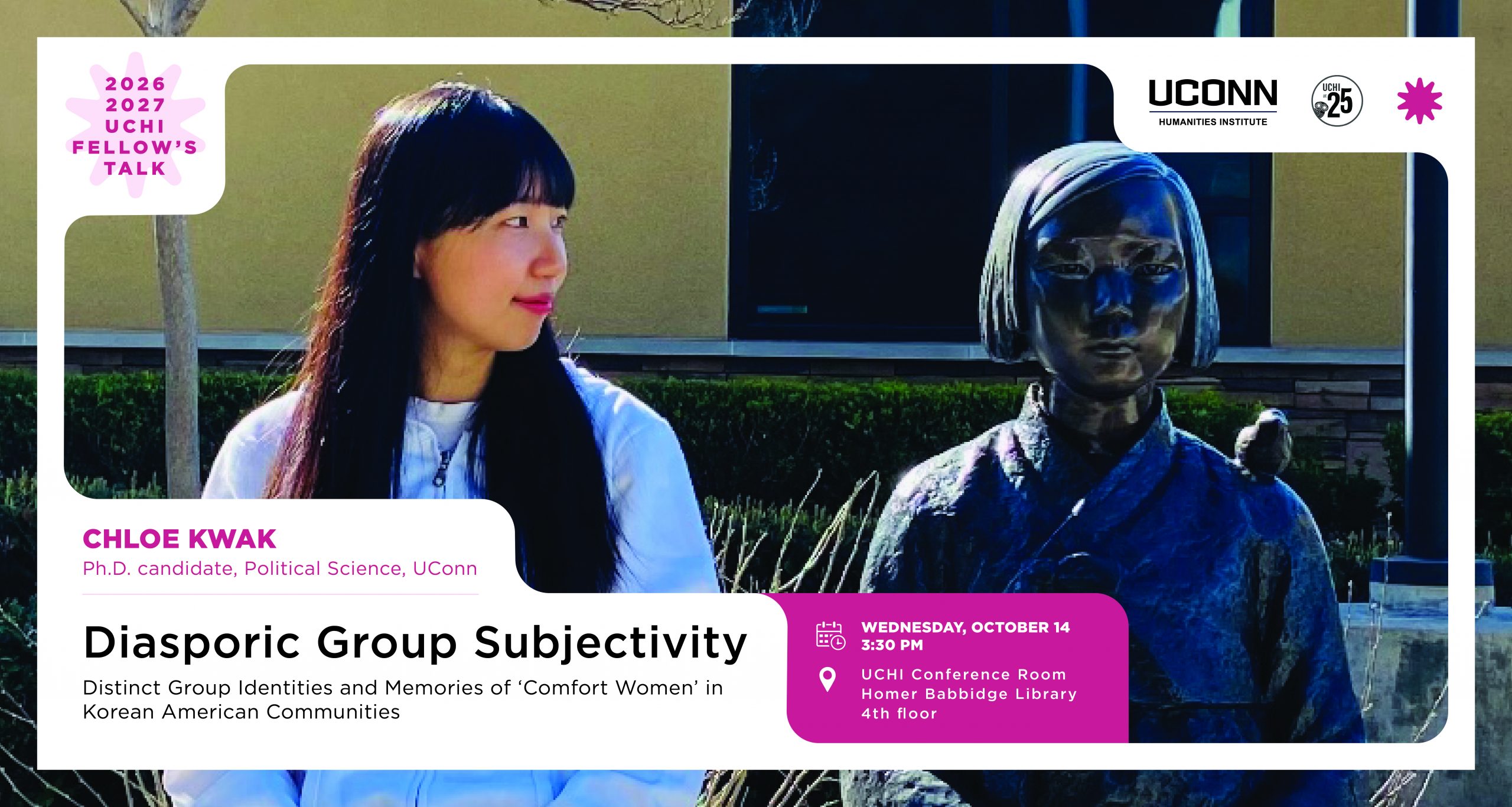
Diasporic Group Subjectivity: Distinct Group Identities and Memories of ‘Comfort Women’ in Korean American Communities
Chloe Kwak (Ph.D. Candidate, Political Science, UConn)
with a response by Emma Amador (History, UConn)
Wednesday, October 14, 2026, 3:30pm, Humanities Institute Conference Room (HBL 4-209)
The event will also be livestreamed with automated captioning.
This talk draws on Chloe Kwak’s dissertation, “Diasporic Group Subjectivity: Distinct Group Identities and Memories of ‘Comfort Women’ in Korean American Communities,” to examine how Korean American community groups construct distinct collective orientations toward themselves, their homeland, and the United States. Through a comparative study of Washington Butterfly for Hope in Virginia and the Connecticut Korean American Action Network, she introduces the concept of diasporic group subjectivity to explain how shared experiences of diaspora shape the ways groups understand who they are and how they relate to historical memory. Drawing on interviews, participant observation, organizational materials, and media sources, Kwak shows that Washington Butterfly members develop a liminal orientation situated between Korean and American belonging, leading them to frame the “comfort women” issue as a universal human rights concern. CTKAAN members, by contrast, remain more strongly oriented toward Korea and approach the issue through a localized Korean historical and ethical framework. The talk demonstrates how diasporic group subjectivity helps explain why communities sharing an ethnic background and historical memory can develop distinct forms of collective identity and memory activism. Ultimately, this research seeks to illuminate why these small diasporic groups matter beyond their immediate communities by examining their roles as pressure groups and local opinion-shaping actors in the United States, and how their activism contributes to the broader domestic environment in which U.S. foreign policy toward South Korea and Japan is debated and formulated.
Chloe M. Kwak is a Ph.D. candidate in Political Science and a 2026–2027 Draper Dissertation Fellow at the University of Connecticut Humanities Institute. Her research lies at the intersection of international relations, feminist theory, diaspora studies, memory politics, international law, and transitional justice, with a particular focus on the politics and memory of “comfort women.” Her dissertation, “Diasporic Group Subjectivity: Distinct Group Identities and Memories of ‘Comfort Women’ in Korean American Communities,” examines how Korean American community groups develop distinct collective subjectivities and forms of memory activism. Her work has been published or is forthcoming in the International Feminist Journal of Politics and The Asia-Pacific Journal: Japan Focus.
Emma Amador Assistant Professor of History at the University of Connecticut. Her work focuses on Puerto Ricans, Latinas in the United States, and histories of women and gender. Dr. Amador’s first book, The Politics of Care Work: Puerto Rican Women Organizing for Social Justice (Duke University Press, 2025), received an Honorable Mention for the Sharon Harris Book Award from UCHI. As a Justice, Equity, and Repair fellow at UCHI, Dr. Amador will work on her second book, “Bright Futures: How Antonia Pantoja’s Vision of Community Organizing Sparked Movements for Latina and Puerto Rican Rights,” a biography of trailblazing Afro-Puerto Rican civil rights activist Dr. Antonia Pantoja who became the first Puerto Rican woman to receive the Presidential Medal of Freedom in 1996.
Access note
If you require accommodation to attend this event, please contact us at uchi@uconn.edu or by phone (860) 486-9057. We can request ASL interpretation, computer-assisted real time transcription, and other accommodations offered by the Center for Students with Disabilities. Requests should be made at least five business days in advance whenever possible.
Photography disclaimer
Photographs may be taken at this event and posted on social media or otherwise used for communication purposes.
Support UCHI
For twenty-five years the University of Connecticut Humanities Institute has served as the hub for the study of human society and culture at UConn. Help us celebrate UCHI at 25 with a gift to the Institute. Every gift will help us promote innovation and creativity in humanities research for the next twenty-five years.