UCHI at 25

Fellow’s Talk: Ananda Griffin on Emotions and Black Feminist Thought

2026–27 UCHI Fellow's Talk. "Feel: An Account of Emotion." Ananda Griffin, Ph.D. Candidate, Philosophy, UConn. September 30, 3:30pm, UCHI Conference Room, HBL 4th Floor.

Feel!: An Account of Emotion

Ananda Griffin (Philosophy, Philosophy, UConn)

with a response by Daniel Adler (Anthropology, UConn)

Wednesday, September 30, 2026, 3:30pm, Humanities Institute Conference Room (HBL 4-209)

The event will also be livestreamed with automated captioning.

Register to attend virtually
In her 1984 speech “The Uses of Anger,” Audre Lorde describes anger as “a grief of distortions between peers” and “loaded with information and energy.” The goal of this project is to take her and other Black feminists’ claims about emotion seriously and place them in conversation with current philosophical and psychological discourses on the topic. “Feel: An Account of Emotion” argues that emotions have elements of feeling, evaluation, and motivation. Current debates argue that emotion is primarily or merely one of these things, while Black feminists often argue that emotion is more than a plot for action, a judgement, or a bodily sensation alone. “Feel!” argues that the experience of an emotion entails the brain tracking a feeling in the body, associating the sensation to past instances of it, while also prioritizing and/or deprioritizing certain sorts of action. This project introduces the concept of an affective scheme: a frame based on our associations with a given context and feeling through which we interpret events that also guides emotional (in)action. Importantly, affective schemes are, in part, formed by our upbringings, peers, and socio-political contexts; they emphasize the interconnectedness of our emotions. “Feel!” adds to the chorus of Black feminist philosophers of emotion, providing a new framework with which to think about the layers of emotional experience.

Ananda Griffin is a 5th Year PhD candidate in the Philosophy Department at UConn and a proud graduate of Spelman College in Atlanta, GA, Ananda’s dissertation is titled, “What We Learn from Tears and Laughter: An Account of Emotion as an Epistemic Resource,” which explores the ways that emotion helps us understand the world around us. Ananda argues that emotion plays two important epistemic roles: allowing us to make meaning of the world around us and motivating the pursuit of knowledge. Additionally, the dissertation analyzes the harms that arise from the denial of emotion’s epistemic impact. Ananda shows the ways that affective injustice, social practices that systemically invalidate certain people’s emotions, can sometimes function as an epistemic injustice, invalidating or ignoring a group’s knowledge on account of their identity. She argues that these injustices do not pass without resistance, using Black women of the Great Migration as key examples of epistemic and affective refusal. Ananda draws on Black Feminism, Philosophy of Mind, Psychology, Social Epistemology, and other fields. 

Daniel Adler is and Associate Professor in the Department of Anthropology with over 30 years experience investigating ancient human behaviors, cultures, and lifeways in Western Europe, the Middle East, and the south Caucasus. Since 1995 he has directed over 10 interdisciplinary archaeological projects in the republics of Georgia and Armenia spanning the last 2,000,000 to 20,000 years, with a primary focus on understanding Neanderthal-Modern Human interactions and what it means to be human. This work seeks to bridge the perceived behavioral and cognitive gaps between Neanderthals and ourselves, challenge traditional beliefs in our own uniqueness and question the validity of our sapiens-centric worldview, develop a deeper appreciation of Neanderthal resiliency and agency, and contribute to the ongoing restoration of Neanderthal humanity.

Access note

If you require accommodation to attend this event, please contact us at uchi@uconn.edu or by phone (860) 486-9057. We can request ASL interpretation, computer-assisted real time transcription, and other accommodations offered by the Center for Students with Disabilities. Requests should be made at least five business days in advance whenever possible.

Photography disclaimer

Photographs may be taken at this event and posted on social media or otherwise used for communication purposes.

Support UCHI

For twenty-five years the University of Connecticut Humanities Institute has served as the hub for the study of human society and culture at UConn. Help us celebrate UCHI at 25 with a gift to the Institute. Every gift will help us promote innovation and creativity in humanities research for the next twenty-five years.
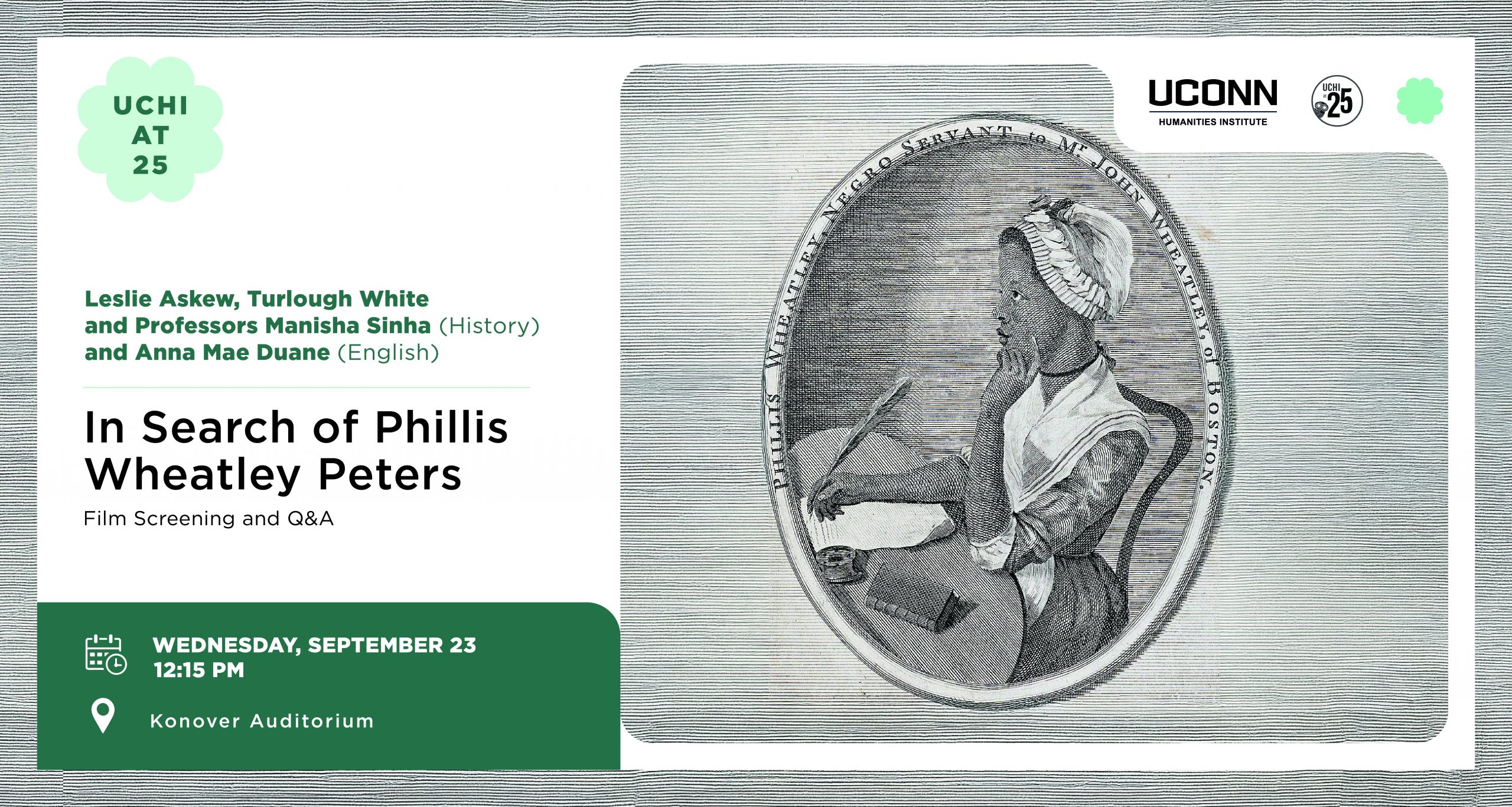
In Search of Phillis Wheatley Peters: Film Screening and Q&A

UCHI at 25: In search of Phillis Wheatley Peters, film screening and Q&A, with filmmakers Leslie Askew and Turlough White and Professors Manisha Sinha and Anna Mae Duane. September 23, 12:15pm, Konover.

In Search of Phillis Wheatley Peters: Film Screening and Q&A

a UCHI at 25 event

with filmmakers Leslie Askew and Turlough White and Professors Manisha Sinha (History) and Anna Mae Duane (English)

Wednesday, September 23, 2026, 12:15pm, Konover Auditorium

In Search of Phillis Wheatley Peters (dir. Leslie Askew) is a documentary that uncovers the little-known love story of Phillis Wheatley—America’s first Black published poet—and John Peters, a free Black man she married in 1778.

Drawing on the groundbreaking research of historian Dr. Cornelia Dayton, the film brings newly unearthed archival discoveries to life, revealing the couple’s pursuit of autonomy, dignity, and survival in Revolutionary-era Boston. Featuring insights from leading scholars and poets—including Dr. Vincent Carretta, Dr. Cornelia Dayton, Dr. Nicole Aljoe, Dr. Manisha Sinha, Dr. Kabria Baumgartner, and Dr. Joanne Gabbin—the film reimagines Phillis not only as a literary icon but as a woman who chose love, partnership, and resistance against extraordinary odds.

The short film (35 min) will be followed by a Q&A with director Leslie Askew and producer Turlough White and Professors Manisha Sinha (History) and Anna Mae Duane (English).

Access note

If you require accommodation to attend this event, please contact us at uchi@uconn.edu or by phone (860) 486-9057. We can request ASL interpretation, computer-assisted real time transcription, and other accommodations offered by the Center for Students with Disabilities. Requests should be made at least five business days in advance whenever possible.

Photography disclaimer

Photographs may be taken at this event and posted on social media or otherwise used for communication purposes.

Support UCHI

For twenty-five years the University of Connecticut Humanities Institute has served as the hub for the study of human society and culture at UConn. Help us celebrate UCHI at 25 with a gift to the Institute. Every gift will help us promote innovation and creativity in humanities research for the next twenty-five years.
Fellow’s Talk: Sarah Boateng on Black Women’s Agency in Maternal Healthcare

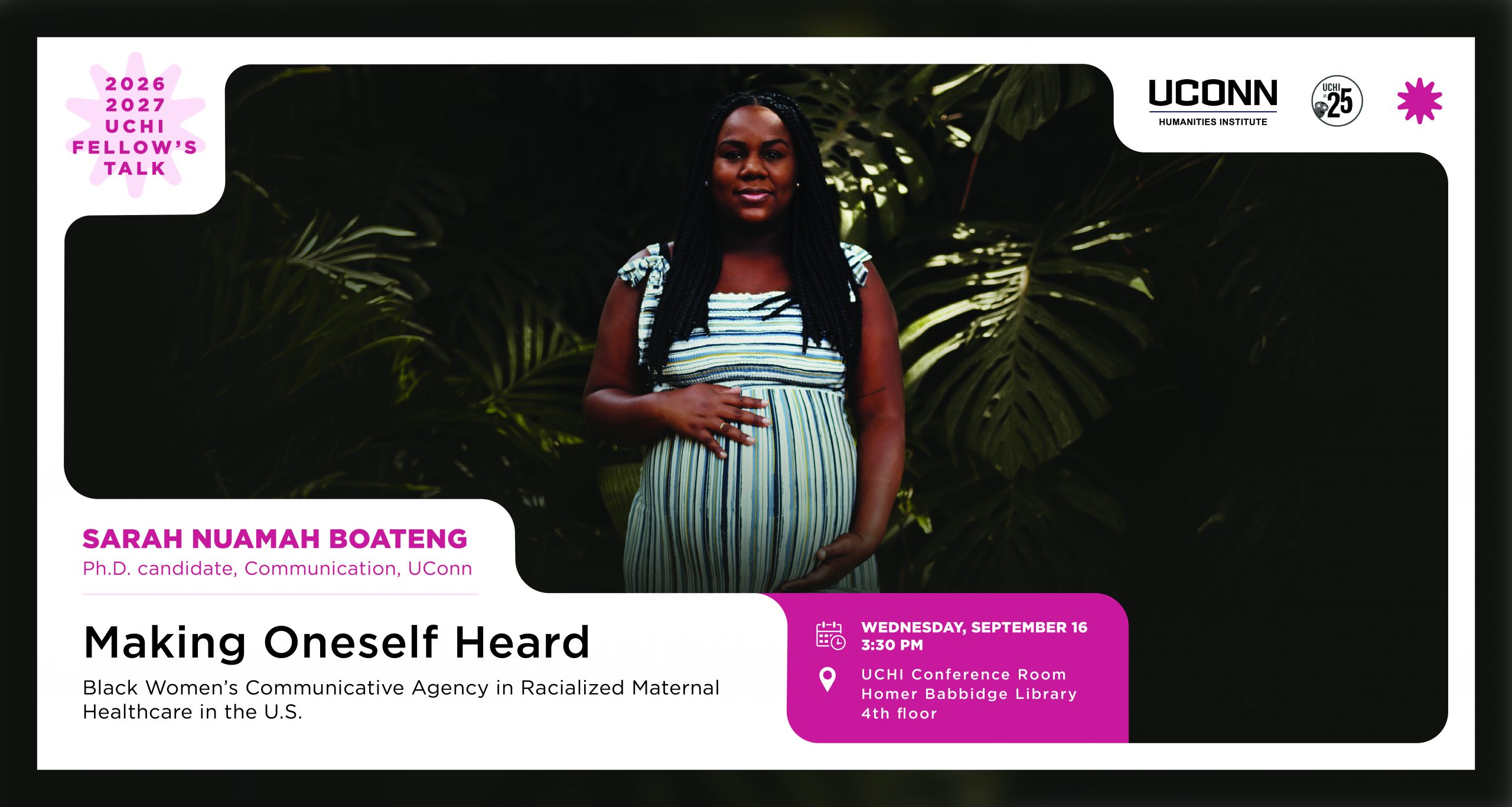
2026–27 UCHI Fellow's talk. Making Oneself Heard: Black Women’s Communicative Agency in Racialized Maternal Healthcare in the U.S.. Sarah Nuamah Boateng (PhD candidate, communication, UConn. Wed, Sept 16, 2026. 3:30 pm, UCHI conference room, homer babbidge library, fourth floor.

Making Oneself Heard: Black Women’s Communicative Agency in Racialized Maternal Healthcare in the U.S.

Sarah Nuamah Boateng (Ph.D. candidate, Communication, UConn)

with a response by Eleni Coundouriotis (English & Comparative Literary Studies, UConn)

Wednesday, September 16, 2026, 3:30pm, Humanities Institute Conference Room (HBL 4-209)

The event will also be livestreamed with automated captioning.

Register to attend virtually
Maternal health disparities disproportionately impact women of color, particularly Black women. Existing research documents the mistreatment of Black women in clinical settings, which often marginalizes their voices and underscores the necessity for agency. This dissertation investigates the lived experiences of Black women to understand how agency is enacted through communication in perinatal care contexts within clinical settings across the United States.

Employing a qualitative methodology and a critical perspective, this dissertation introduces a communicative agentic framework to analyze how Black women in the United States navigate perinatal healthcare interactions within a racialized medical system. The research positions communication as a central site for agency, resistance, and meaning-making, providing insights to improve patient–provider relationships and advance equitable maternal healthcare.

Sarah Nuamah Boateng is a final-year doctoral student in Communication at the University of Connecticut whose research focuses on health communication, specifically women’s reproductive health and rights in interpersonal and organizational contexts. As a qualitative communication researcher, she investigates communication dynamics at the intersections of gender, structural inequities, and cultural contexts, particularly within maternal healthcare interactions involving women of color. Her work aims to elucidate how these dynamics contribute to health disparities and has also addressed communication challenges faced by women living with chronic illness. Her research has been published in leading journals, including Social Science & Medicine and the Journal of Health Communication, and has received recognition from the Christine N. Witzel Award Fund and the UConn 100 Years of Women Scholarship. She is committed to advancing quality and equitable healthcare for women of all racial and demographic backgrounds.

Eleni Coundouriotis is Professor of English and Comparative Literary Studies at the University of Connecticut. Her research focuses on the narration and documentation of war, humanitarianism, statelessness, and the history of anticolonial struggle. She is the author of Claiming History: Colonialism, Ethnography and the Novel (1999), The People’s Right to the Novel: War Fiction in the Postcolony (2014) and Narrating Human Rights in Africa (2021).

Access note

If you require accommodation to attend this event, please contact us at uchi@uconn.edu or by phone (860) 486-9057. We can request ASL interpretation, computer-assisted real time transcription, and other accommodations offered by the Center for Students with Disabilities. Requests should be made at least five business days in advance whenever possible.

Photography disclaimer

Photographs may be taken at this event and posted on social media or otherwise used for communication purposes.

Celebrating UCHI at Twenty-Five

A Message from Director Anna Mae Duane

UCHI at 25This year is a special one for all of us at UCHI, as we celebrate our 25th anniversary. From a small room nestled on the third floor of the Austin building to a thriving hub of activity here in the library, the Humanities Institute has grown and thrived because we have put our values into action.

Our fellowship program reflects the value of excellence in research and of the transformative power of shared knowledge. So, it’s only fitting that we spend this anniversary year celebrating our fellows and the world-class research they have produced over the past quarter-century. Keep an eye out for events showcasing our fellows’ award-winning works of history, philosophy, and filmmaking (to name just a few!). We are particularly excited to showcase our newest cohort of fellows: our undergraduate fellowship program, now entering its fifth year, has a growing cohort of accomplished alumni. These students, who have pursued their research projects here at UCHI alongside faculty and graduate students, are now charting new paths as Fulbrighters overseas, as playwrights in New York City, and as graduate students at Ivy League institutions.

Another indication of the global significance of humanities research can be found in UCHI’s growing international partnerships. This year will see expanding collaborations with colleagues in Japan and Morocco who are asking, alongside us, how artificial intelligence will reshape human life. As AI homogenizes so much of the text we find on our phones and laptops, we need the expertise the humanities bring to the complexities of cultural expression across borders and across disciplines.

Here at home, we see that expertise at work as our Humanistic AI Working Group continues to grow, bringing together scholars across the humanities and social sciences to ask how AI is reshaping our understanding of labor, authorship, and care. Their work is a vivid reminder that the humanities are not a retreat from technological change but rather provide the very skills we need to navigate that change wisely.

The humanities offer the tools that allow us to determine what makes human life meaningful, and to reassert the transformative power of human creativity and collaboration as our most valuable resources. It is our shared commitment to better understanding our world and one another that has built this institute, and I have no doubt that this commitment that will carry us through the next twenty-five years.