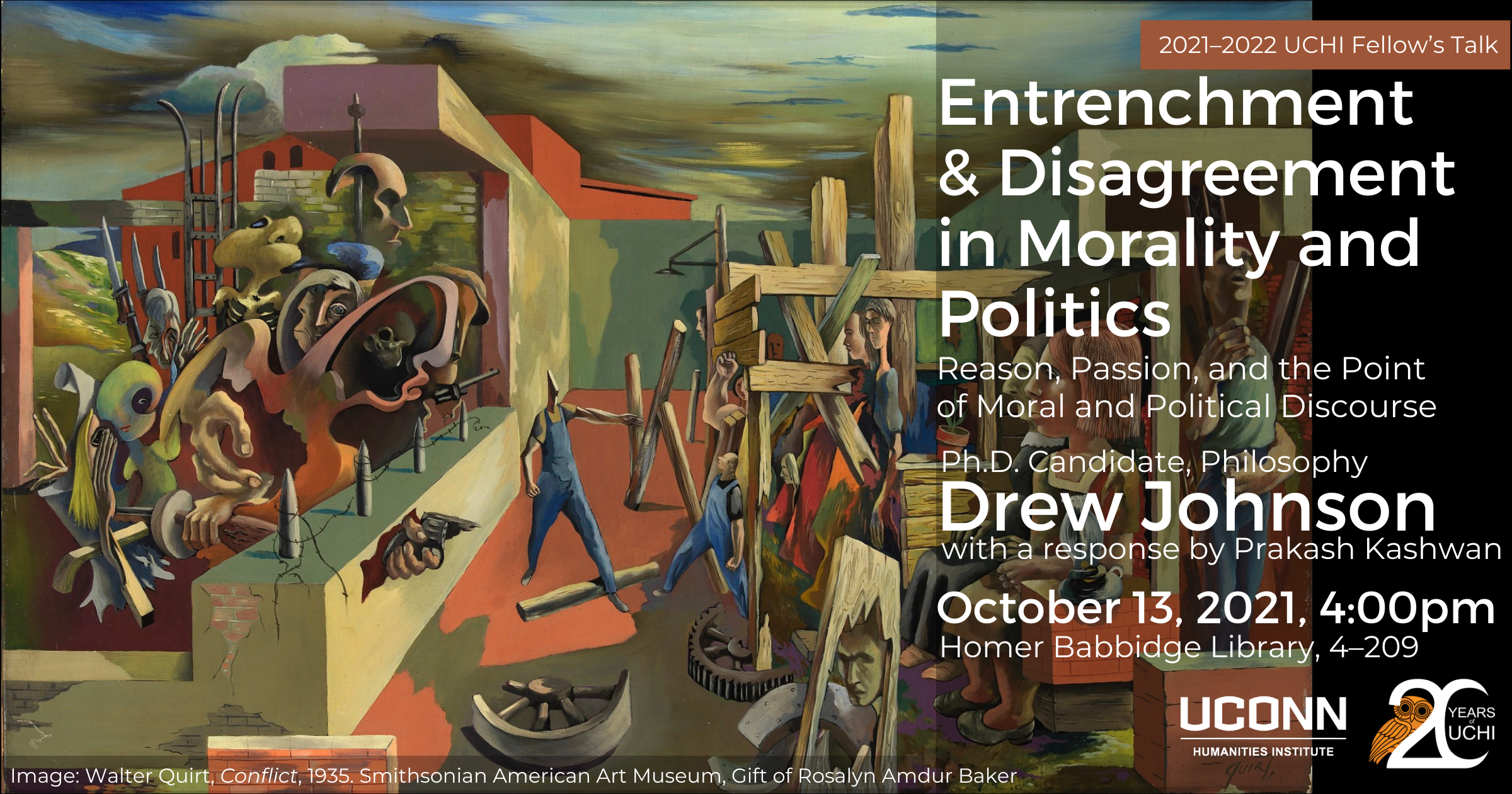
Entrenchment and Disagreement in Morality and Politics: Reason, Passion, and the Point of Moral and Political Discourse
Drew Johnson (Ph.D. Candidate, Philosophy, UConn)
with a response by Prakash Kashwan (Political Science, UConn)
Wednesday, October 13, 2021, 4:00pm. Homer Babbidge Library, 4-209.
Add to Google calendar Add to Office 365 calendar Add to other calendar
The event will also be livestreamed.
To attend virtually, register here
Disagreement in moral and political matters is particularly widespread and often resists easy resolution. Recent work by social epistemologists and psychologists has offered useful tools for analyzing disagreement and polarization both online and in person, by describing how general cognitive biases and heuristics, as well as the affective dimension of normative judgments, make certain moral and political beliefs resistant to rational revision through reasonable discourse. This talk discusses the affective and social aspects of moral and political judgment, how they contribute to explanations of deep disagreement and polarization, and their implications for the possibility of moral and political knowledge.
Drew Johnson is a Philosophy PhD candidate at the University of Connecticut. His dissertation project, “A Hybrid Theory of Ethical Thought and Discourse,” examines the nature and function of ethical thought and discourse. Drew has published on skepticism, deep disagreement and intellectual humility, and on self-knowledge (including co-authored work with Dorit Bar-On). During the Summer of 2019, he was the recipient of the Ruth Millikan Graduate Research Fellowship, awarded by the UConn Philosophy Department. Drew is currently a Dissertation Scholar at the University of Connecticut Humanities Institute.
Prakash Kashwan is an Associate Professor of Political Science and Co-Director of the Research Program on Economic and Social Rights, Human Rights Institute, University of Connecticut, Storrs. He is the author of the widely reviewed and acclaimed book Democracy in the Woods: Environmental Conservation and Social Justice in India, Tanzania, and Mexico (Oxford University Press, 2017) and a Co-Editor of the journal Environmental Politics. He also serves on the editorial advisory boards of Earth Systems Governance, Progress in Development Studies, Sage Open, and Humanities & Social Sciences Communications. Dr. Kashwan is a member of the global expert group for Scoping of Transformative Change Assessment by the Intergovernmental Science-Policy Platform on Biodiversity and Ecosystem Services (IPBES), a member of the Academic Working Group (AWG) on International Governance of Climate Engineering (2016–18), a Senior Research Fellow of the Earth System Governance (ESG) Project, a member of the Climate Social Science Network (CSSN) established by Brown University, and an external faculty affiliate of the Ostrom Workshop. Dr. Kashwan is also the vice chair of the Environmental Studies Section of the International Studies Association (ISA). In addition to nearly two dozen scholarly publications, his research has been cited in national and international media, including the New York Times, Deutsche Welle, Huffington Post, NPR, Scientific American, and Down to Earth. Dr. Kashwan has written several influential commentaries for popular venues, such as the Conversation, the Guardian, Al-Jazeera, and the Washington Post.
If you require accommodation, including live transcription, to attend this event, please contact us at uchi@uconn.edu or by phone (860) 486-9057.
 Paul Bloomfield was a 2007–2008 UCHI faculty fellow and
 Alea Henle was a 2011–12 dissertation research scholar. A librarian and historian, she is now is Head of Access & Borrow at Miami University. She has a Masters in Library Science from Simmons College and a Ph.D. in History from the University of Connecticut. Over the past years, she’s worked in libraries from Washington, D.C. to Colorado to New Mexico and taught classes in history, librarianship, archives, and records management. Her research interests center on how decisions in libraries, archives, research centers, and commercial database providers increasingly shape the resources available–making materials paradoxically both easier and more difficult to locate.
 On the Horizon of World Literature compares literary texts from asynchronous periods of incipient literary modernity in different parts of the world: Romantic England and Republican China. These moments were oriented alike by “world literature” as a discursive framework of classifications that connected and re-organized local articulations of literary histories and literary modernities. World literature, in this sense, provided and continues to provide a condition of possibility for conversation between cultures as well as their mutual provincialization.