If you require accommodation to attend this event, please contact us at uchi@uconn.edu or by phone (860) 486-9057.
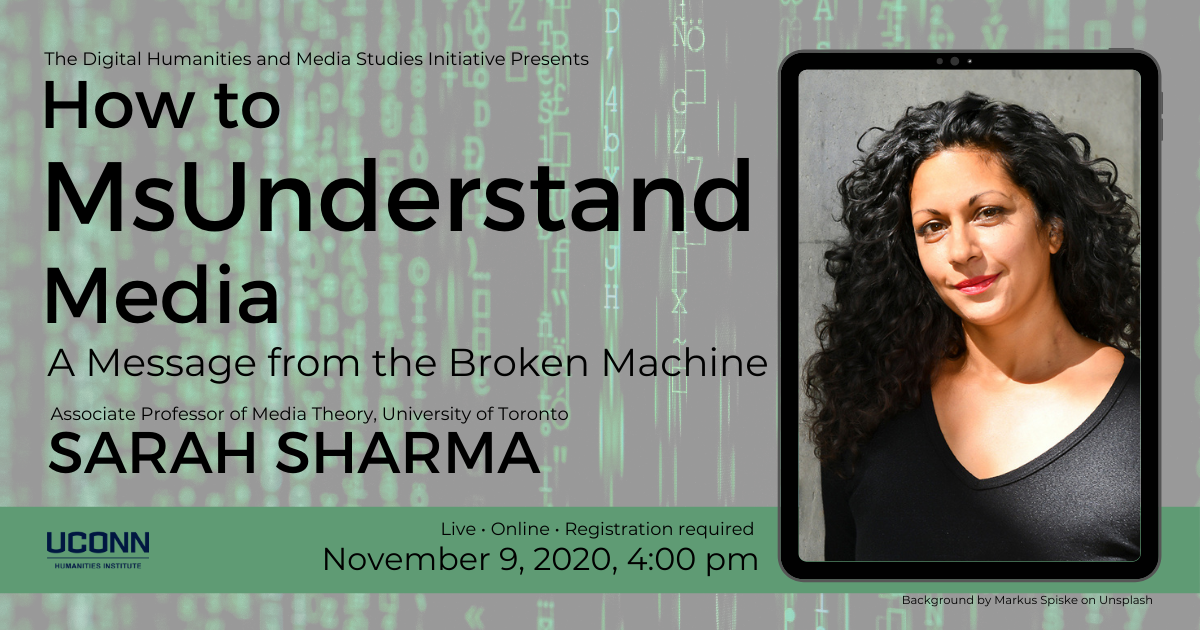
The Digital Humanities and Media Studies Initiative presents:
How to MsUnderstand Media: A Message from the Broken Machine
Sarah Sharma (Associate Professor of Media Theory, University of Toronto)
November 9, 4:00–5:00pm
An online webinar. Registration is required for attendance.
Sarah Sharma is Director of the McLuhan Centre for Culture and Technology at the University of Toronto and Associate Professor of Media Theory at the ICCIT/Faculty of Information. Her research and teaching focuses on the relationship between technology, time and labour with a specific focus on issues related to gender, race, and class. She is the author of In the Meantime: Temporality and Cultural Politics (Duke UP, 2014). Sarah is currently at work on two projects that take up McLuhan’s media theory for feminist ends. The first is a monograph tentatively titled Broken Machine Feminism which explores the relationship between technology and patriarchal cultures of exit. This project argues for the necessity of a feminist techno-determinist stance in order to address contemporary power dynamics as they intersect with the technological. The second is an edited book collection, MsUnderstanding Media: A Feminist Medium is the Message (with Rianka Singh), which offers a feminist retrieval of McLuhan’s famous adage that the medium is the message.
This talk will outline Sarah’s work on a feminist approach to McLuhan and her argument for the new possibilities of a feminist techno-determinism.
 From transgender persons seeking to become the gender they truly are to religious business owners seeking exemption from anti-discrimination laws, a wide range of political claims are cast in terms of authenticity. Despite the ubiquity of these claims, it is not always clear what is at stake and whether we should understand these stakes as political. Part of the difficultly is that our most prevalent ways of framing the stakes of authenticity claims—what Hagel calls the ethical frame and the recognition frame—downplay their political character. In this paper, Hagel articulates a third way, found in the work of Jean-Jacques Rousseau. For Rousseau, what is at stake in becoming authentic is our individual well-being, the character of our social world, and our possibilities for freedom and equality. In this chapter, Hagel draws out this last set of stakes in Rousseau’s work, articulating them as the democratic frame. According to it, what makes authenticity so crucial is the way it secures our freedom and equality. Even when Rousseau articulates the stakes of authenticity in terms of a more ethical or recognitional reading, we can read him against himself to see how this democratic framing remains implicit. Hagel concludes by showing that understanding the stakes of authenticity in terms of freedom and equality is promising in three ways: it helps us grasp the causes and consequences of becoming authentic better than alternative frames; it avoids some of the problems of essentialism and paternalism that arise in the other two frames; and it offers us a promising new way of thinking about authenticity—in which one is authentic when one develops oneself in a way that enhances, rather than corrodes, one’s possibilities for freedom.